
The Music Room
Classification
Department
Smithsonian Collection
Museum
Smithsonian American Art Museum
Credit
Gift of Charles Lang Freer
Accession Number
F1898.248
Rights
Public Domain
Tags
About this artwork
2, 1
Art Historical Context
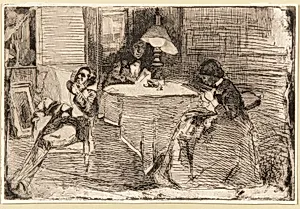
James McNeill Whistler, renowned American artist (1834-1903) known for his elegant compositions and advocacy of "art for art's sake," created *The Music Room* in 1858, early in his career while living in Paris. This intimate etching captures a domestic interior, blending portraiture with everyday life—likely featuring figures engaged in reading amid the refined setting of a music room. part of the French Etching Revival, Whistler's print exemplifies his precocious skill in the medium, where acid bites into a metal plate to produce delicate lines and subtle tones, evoking a sense of quiet intimacy. The work reflects Whistler's influences from French Realists like Courbet, prioritizing atmosphere over narrative detail. Its classification as a print highlights the era's fascination with reproductive techniques, allowing artists to distribute intimate scenes widely. Tagged with themes of interiority and leisure, it offers a glimpse into 19th-century bourgeois life in Europe, bridging American and international art. Generously gifted to the Smithsonian American Art Museum by collector Charles Lang Freer, a major patron of Whistler, *The Music Room* remains a gem in the Freer collection. Visitors will appreciate its technical finesse and the artist's emerging harmony of form and mood, a precursor to his later symphonic masterpieces.