
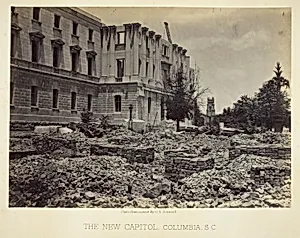
The New Capitol, Columbia, SC
Medium
Albumen print, plate 52 from the album "Photographic Views of the Sherman Campaign" (1866)
Dimensions
Image/paper: 25.6 × 36 cm (10 1/8 × 14 3/16 in.); Album page: 41 × 50.6 cm (16 3/16 × 19 15/16 in.)
Classification
albumen silver print
Department
Photography and Media
Museum
Art Institute of Chicago
Accession Number
145511
Rights
Public Domain
Art Historical Context
George N. Barnard’s *The New Capitol, Columbia, SC*1865) is a poignant albumen silver print, plate 52 from his seminal album *Photographic Views the Sherman Campaign* (6). Captured in the immediate aftermath of the American Civil War, this .6 × 36 cm image depicts the scarred facade of South Carolina’s state capitol in Columbia, its columns and walls pockmarked by cannon fire and shadowed by destruction. As a pioneering Civil War photographer, Barnard documented Union Army’s devastating March to the Sea under General William Tecumseh Sherman, using the era’s albumen process—egg white-coated paper sensitized with silver nitrate—to produce richly toned, detailed prints that brought the war’s grim reality to life. This photograph holds immense historical significance as visual testimony to the February 1865 burning of Columbia, a key Confederate stronghold. Sherman’s forces targeted the city to cripple Southern morale and infrastructure, leaving the “New Capitol”—completed just before the war—a symbol of ruin and Reconstruction’s harsh beginnings. Barnard’s straightforward composition, with its stark perspective and meticulous detail, exemplifies 19th-century documentary photography’s shift toward unvarnished truth-telling. Housed in the Art Institute of Chicago’s Photography and Media Department, this work invites visitors to reflect on war’s toll, blending artistic precision with unflinching reportage. It remains a vital record of a pivotal moment in American history.
About the Artist
George N. Barnard · 1819–present
George N. Barnard (1819–1902) was a pioneering American photographer whose six-decade career spanned the dawn of the medium, from daguerreotypes to Civil War documentation. Born into a farming family in Coventry, Connecticut, on December 23, 1819, he lost his father at age seven and apprenticed in family businesses before marrying in 1843 and relocating to Oswego, New York. There, he launched one ...