
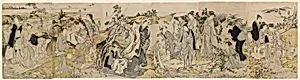
The Noda Jewel River, from a hexaptych depicting the Six Jewel Rivers
c. 1781/89
Medium
Color woodblock print; sheet from oban hexaptych
Classification
woodblock print
Department
Arts of Asia
Museum
Art Institute of Chicago
Accession Number
18928
Rights
Public Domain
Art Historical Context
Welcome to the Arts of Asia gallery at the Art Institute of, where we spotlight *The Noda Jewel River*, stunning color woodblock print by Kubo Shunman, around 1781–89. Shunman, a versatile Edo-period artist and poet (1757–1820), was renowned for his ukiyo-e works—"pictures of the floating world"— captured Japan's transient beauties. This sheet forms part of a rare hexaptych, a six-panel composition depicting the legendary Six Jewel Rivers, celebrated in classical Japanese poetry for their crystalline waters and scenic splendor. Printed in the lavish *nishiki-e* (brocade picture) style, this oban-sized sheet (roughly 10 x 14 inches) showcases Shunman's mastery of woodblock techniques. Multiple carved blocks were inked in vibrant hues—vermilion reds, Prussian blues, and subtle gradients—to evoke the river's shimmering flow amid misty mountains and lush banks. When assembled with its companion panels, the hexaptych unfolds a panoramic tribute to nature's poetry. These prints reflect late 18th-century Japan's fascination with *waka* verse and *yūgen* aesthetics, blending literati elegance with popular print culture. Shunman's fusion of delicate lines and bold color elevated woodblocks from ephemeral art to collector's treasures, influencing later masters like Hokusai. Gaze closely to imagine riverside pilgrims reciting ancient odes—timeless jewels indeed! (198 words)
About the Artist
Kubo Shunman · 1757–1820
Japanese, 1757–1820