
The Parisian (Small Plate) (La Parisienne)
1904
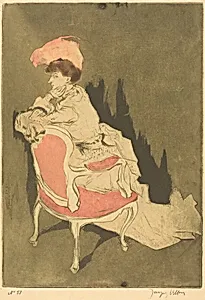
Medium
etching, aquatint, and roulette in green and pink on japan paper
Dimensions
plate: 23.8 x 16.7 cm (9 3/8 x 6 9/16 in.) sheet: 39.9 x 26 cm (15 11/16 x 10 1/4 in.)
Classification
Department
CG-W
Museum
National Gallery of Art, Washington, D.C.
Credit
Ailsa Mellon Bruce Fund
Accession Number
1978.98.1
Rights
Public Domain
Art Historical Context
Jacques Villon’s *The Parisian (Small Plate)* captures the elegance and modernity of early twentieth-century Paris through the figure of a stylish woman Created in 1904, the reflects Villon’s early interest in contemporary urban life and fashionable femininity during the Belle Époque. The title’s reference to a “small plate” suggests it may belong to a series exploring similar subjects at different scales. The work demonstrates Villon’s mastery of intaglio printmaking. By combining etching, aquatint, and roulette, he achieves delicate tonal variations and subtle textures, printed in soft green and pink inks on luxurious japan paper. These techniques allowed him to evoke both the vibrancy of city life and the refined atmosphere associated with Parisian women of the period. As a member of the generation that would later embrace Cubism, Villon here reveals his roots in color experimentation and graphic innovation. The choice of japan paper enhances the print’s luminous quality, making this modest-sized work a fine example of early twentieth-century French printmaking at its most sophisticated.
About the Artist
Jacques Villon · 1875–1963
Jacques Villon, born Gaston Émile Duchamp on July 31, 1875, in Damville, Normandy, hailed from a family brimming with artistic talent. As the eldest of six children, he grew up alongside his brothers Raymond Duchamp-Villon, a pioneering sculptor, and Marcel Duchamp, the renowned Dadaist, as well as his sister Suzanne Duchamp, also a painter. Their maternal grandfather, Émile Frédéric Nicolle, a pr...