
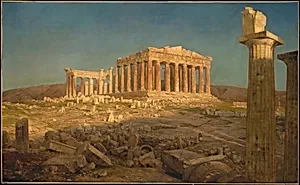
The Parthenon
Medium
Oil on canvas
Dimensions
44 1/2 x 72 5/8 in. (113 x 184.5 cm)
Classification
Painting
Culture
American
Department
The American Wing
Museum
Metropolitan Museum of Art, New York, NY
Credit
Bequest of Maria DeWitt Jesup, from the collection of her husband, Morris K. Jesup, 1914
Accession Number
15.30.67
Rights
Public Domain
Tags
Art Historical Context
Frederic Edwin Church, a leading figure in the Hudson River School of American landscape painting, created *The Parthenon* 1871 after a transformative trip to Greece in 1869. This monumental oil on canvas (44 1/2 x 72 5/8 in.) captures the ancient ruins atop the Acropolis in Athens, bathed in the golden glow of a Mediterranean sunset. Church's journey reflected the 19th-century American fascination with classical antiquity, blending Romanticism's awe of nature with a precise, almost scientific observation of historical sites. Church's masterful technique shines in the luminous effects and intricate details of the weathered marble columns, evoking the sublime power of time and endurance. As a Hudson River School artist, he infused the scene with dramatic light and atmospheric depth, characteristic of luminism—a style emphasizing radiant skies and subtle tonal transitions. The vast canvas invites viewers to immerse themselves in the ruins' timeless grandeur, symbolizing the enduring legacy of ancient Greek democracy and architecture. Now housed in The Metropolitan Museum of Art's American Wing, this work was bequeathed in 1914 by Maria DeWitt Jesup from her husband Morris K. Jesup's collection. It stands as a testament to Church's global vision, bridging American Romanticism with the cultural reverence for classical ruins.
About the Artist
Frederic Edwin Church · 1826–1900
Frederic Edwin Church (1826–1900), born in Hartford, Connecticut, to a prosperous silversmith and banker father, Joseph Church, pursued art from youth thanks to his family's wealth. At age 18, introduced by patron Daniel Wadsworth, he studied under Thomas Cole in Catskill, New York, from 1844 to 1846, sketching across New England and earning Cole's praise for possessing "the finest eye for drawing...