
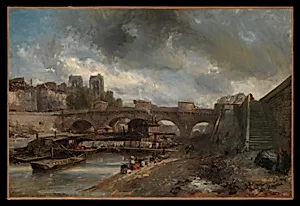
The Pont Neuf
1849–50
Medium
Oil on canvas
Dimensions
21 1/2 x 32 1/8 in. (54.6 x 81.6 cm)
Classification
Paintings
Department
European Paintings
Museum
Metropolitan Museum of Art, New York, NY
Credit
Gift of Mr. and Mrs. Walter Mendelsohn, 1980
Accession Number
1980.203.3
Rights
Public Domain
Tags
Art Historical Context
Johan Barthold Jongkind’s “The Pont Neuf,” created between 1849 and 1850, offers a tranquil view of Paris oldest standing bridge spanning the Seine. in oil on canvas, the modest-sized work (21 ½ by 32 ⅛ inches) depicts the familiar urban scene with boats gliding beneath the bridge’s arches and the gentle flow of the river. The tags—bridges, rivers, boats, and Paris—underscore its focus on the city’s daily rhythms rather than grand spectacle. In the mid-nineteenth century, Paris was rapidly modernizing, and the Pont Neuf remained a vital link between the city’s historic core and its expanding neighborhoods. Jongkind, a Dutch painter active in France, chose this timeless landmark to explore the interplay of light on water and stone. The oil medium allowed him to build subtle layers that capture atmospheric effects and the reflective surface of the river, qualities that would later influence the Impressionists. Today the painting resides in the Metropolitan Museum of Art’s European Paintings collection, a gift that preserves a quiet moment of Parisian life from the eve of Haussmann’s great transformations. Its straightforward subject matter invites viewers to appreciate how ordinary city views became worthy of artistic attention in the 1800s.
About the Artist
Johan Barthold Jongkind · 1819–1891
Johan Barthold Jongkind (1819–1891) was born on June 3 in the rural village of Lattrop, in the Netherlands' Overijssel province, and emerged as a pivotal figure bridging Dutch landscape traditions with the dawn of Impressionism. He began his formal training at The Hague's art academy under the esteemed landscape painter Andreas Schelfhout, whose influence rooted Jongkind in the meticulous depictio...