
The Prison
Medium
Engraving; copy
Dimensions
Sheet (Trimmed): 10 5/8 × 16 5/16 in. (27 × 41.5 cm)
Classification
Prints
Department
Drawings and Prints
Museum
Metropolitan Museum of Art, New York, NY
Credit
Gift of Georgiana W. Sargent, in memory of John Osborne Sargent, 1924
Accession Number
24.63.1107
Rights
Public Domain
Tags
Art Historical Context
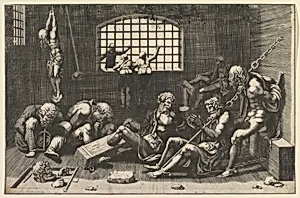
"The Prison" is a striking 16th-century engraving created between 1550 and 1600, attributed to the circle of Giorgio Ghisi after a design by Giulio Romano, or possibly by an anonymous Italian artist of the period. This print, now in the collection of the Metropolitan Museum of Art, captures a dramatic scene of incarceration featuring prisoners and male figures within a stark architectural setting. As a reproductive engraving—a copy of an earlier composition—it exemplifies how Renaissance artists used printmaking to share powerful imagery beyond the original drawing or fresco. Engraving was a vital medium during this era, allowing intricate details and tonal contrasts to be reproduced on paper and distributed widely across Europe. Ghisi, renowned for his precise burin work and faithful translations of designs by masters like Romano, helped bridge painting and print culture. The subject of confinement likely resonated with contemporary viewers, reflecting Renaissance interests in architecture, human suffering, and moral themes. Measuring roughly 10 5/8 by 16 5/16 inches, this trimmed sheet offers a window into 16th-century artistic collaboration and the enduring power of prints to preserve and reinterpret complex narratives for new audiences.
About the Artist
Giorgio Ghisi|Giulio Romano|Anonymous, Italian, 16th century · 1520–1582
Giorgio Ghisi (c. 1520–1582) was one of the most accomplished engravers of the Italian Renaissance, renowned for translating the monumental compositions of Raphael, Giulio Romano, and Michelangelo into the exacting medium of the burin. Born in Mantua, he trained in an environment shaped by the legacy of Giulio Romano's decoration of the Palazzo del Te, and the grandeur of that Mannerist tradition ...