
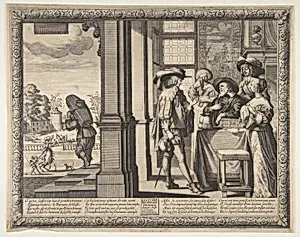
The Prodigal Son Leaves Home
ca. 1636
Medium
Etching
Dimensions
Sheet: 10 1/2 × 13 1/8 in. (26.6 × 33.3 cm)
Classification
Prints
Department
Drawings and Prints
Museum
Metropolitan Museum of Art, New York, NY
Credit
Harris Brisbane Dick Fund, 1926
Accession Number
26.49.1
Rights
Public Domain
Tags
Art Historical Context
In the etching *The Prodigal Son Home* (ca. 1636), French artists Abraham Bosse and I Leblond capture a pivotal moment from the biblical Parable of the Prodig Son (Luke 15:11-32). Here, the wayward son departs his family home, accompanied by men, women, and horses, embarking on his ill-fated journey of extravagance and eventual redemption. This collaborative print, measuring 10 1/2 × 13 1/8 inches, belongs to a series that vividly illustrates the moral tale, making complex religious narratives accessible to 17th-century audiences through affordable prints. Bosse, a master etcher renowned for his precise line work and detailed genre scenes, worked alongside engraver Leblond during France's early Baroque period under Louis XIII. Etching—a technique using acid to bite into metal plates—allowed for intricate textures, fluid lines, and atmospheric depth, ideal for storytelling. Bosse's style, influenced by Jacques Callot, emphasized everyday figures and moral drama, bridging religious devotion with emerging realism in printmaking. Housed in the Metropolitan Museum of Art's Drawings and Prints department (Harris Brisbane Dick Fund, 1926), this work highlights prints' role in disseminating scripture and virtue amid the Counter-Reformation. Its lively depiction of departure evokes the parable's timeless themes of folly, loss, and forgiveness, inviting viewers to reflect on human frailty.
About the Artist
Abraham Bosse|Jean I Leblond · 1602–1676
Abraham Bosse (1604–1676) was a French printmaker and theorist whose approximately 1,600 etchings provide an unparalleled visual record of 17th-century French life. Born to Huguenot parents in Tours, he trained in Paris under Melchior Tavernier and became a devoted follower of Jacques Callot's technical innovations. Bosse's meticulous etchings depicted subjects ranging from daily life and fashion ...