
The Prodigal Son Leaves Home
ca. 1636
Medium
Etching and engraving
Dimensions
Sheet: 11 7/8 × 14 1/16 in. (30.1 × 35.7 cm)
Classification
Prints
Department
Drawings and Prints
Museum
Metropolitan Museum of Art, New York, NY
Credit
The Elisha Whittelsey Collection, The Elisha Whittelsey Fund, 1951
Accession Number
51.501.2291
Rights
Public Domain
Tags
Art Historical Context
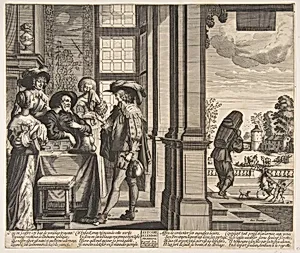
In the poignant etching and engraving *The Prodigal Son Leaves Home* (ca. 1636), French artist Abraham Bosse captures a moment of profound sorrow from the Biblical parable in Luke 15. The scene unfolds in a dimly lit interior, where a young man bids farewell to his family—men and women gathered in quiet anguish—as he sets off on his ill-fated journey of dissipation. Bosse's masterful use of etching for fluid lines and engraving for fine details conveys the emotional weight of the moment, with subtle shading evoking the heaviness of impending loss. Created during the Baroque era in 17th-century France, this print reflects the period's fascination with moral and religious narratives, popularized through affordable reproductive techniques. Bosse, a key figure in the Académie Royale de Peinture et de Sculpture, excelled in genre scenes and domestic interiors, making complex stories accessible to a wide audience via prints like this one (11 7/8 × 14 1/16 in.). Housed in the Metropolitan Museum of Art's Elisha Whittelsey Collection, it exemplifies how printmaking democratized art, inviting viewers to reflect on themes of folly, sadness, and eventual redemption. This work not only showcases Bosse's technical precision but also underscores the cultural role of such images in reinforcing Christian virtues amid France's artistic and religious upheavals.
About the Artist
Anonymous|Abraham Bosse
In the vast tapestry of art history, "Anonymous" stands not as a singular individual but as a collective designation for countless unidentified creators whose works have endured across millennia. These artists, spanning prehistoric cave painters to medieval illuminators and folk craftsmen, produced the foundational layers of human visual culture. Prior to the Renaissance, when individual fame emer...