
The Raising of Tabitha
1501 to 1550
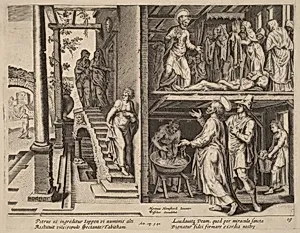
Medium
engraving
Classification
Department
CG-E
Museum
National Gallery of Art, Washington, D.C.
Credit
Ailsa Mellon Bruce Fund
Accession Number
1974.33.26
Rights
Public Domain
Art Historical Context
"The Raising of Tabitha" is a 16th-century engraving by Philip Galle after a design by the Dutch artist Maerten van Heemskerck. Created between 1501 and 1550, the print depicts the biblical miracle from the Book of Acts in which the apostle Peter restores Tabitha (also known as Dorcas) to life. As an engraving, it belongs to a medium prized during the Renaissance for its ability to reproduce intricate details and reach wide audiences through multiple impressions. Van Heemskerck, active in the Netherlands, often drew on Italian Renaissance influences while working in a Mannerist style that emphasized dramatic compositions and expressive figures. Galle’s faithful translation of the design into copperplate engraving highlights the collaborative nature of printmaking at the time, allowing complex religious narratives to circulate beyond church walls and private collections. Housed in the National Gallery of Art through the Ailsa Mellon Bruce Fund, this work exemplifies how prints served both devotional and educational purposes in early modern Europe. Its crisp lines and careful modeling invite viewers to reflect on themes of faith, compassion, and renewal central to the story.
About the Artist
Philip Galle after Maerten van Heemskerck
**Philip Galle (1537–1612)** was a leading Dutch engraver, printmaker, and publisher of the late Renaissance, renowned for his reproductive engravings after prominent painters of his era, including Maerten van Heemskerck. Born in Haarlem, he trained under the humanist and engraver Dirck Volkertsz. Coornhert and began his career producing prints after local artists. Galle established himself as an...