
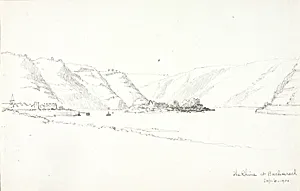
The Rhine at Bacharach
Medium
Drawing
Classification
Drawing
Department
Smithsonian Collection
Museum
Smithsonian American Art Museum
Credit
Smithsonian American Art Museum, Bequest of Carolann Smurthwaite in memory of her mother, Caroline Atherton Connell Smurthwaite
Accession Number
1983.83.177
Rights
Public Domain
Tags
Art Historical Context
George Elbert Burr's *The Rhine at Bacharach* (1900) captures the timeless beauty of Germany's Romantic Rhine River at the picturesque town of Bacharach. This drawing, housed in the Smithsonian American Art, reflects Burr's skill as an American artist who often explored dramatic landscapes. Created at the turn of the 20th century, it evokes the era's fascination with Europe's historic river valleys, where medieval castles and vineyards dotted the shores, inspiring travelers and artists alike. As a drawing, the work highlights Burr's mastery of line and tone to convey atmosphere and light—techniques central to his oeuvre of atmospheric landscapes. The Rhine, a vital artery of European trade and culture for centuries, symbolized nature's grandeur and human history, making Bacharach's bend in the river a quintessential subject. This piece, bequeathed to the Smithsonian in memory of Caroline Atherton Connell Smurthwaite, offers visitors a serene glimpse into early 1900s artistic wanderlust. (178 words)
About the Artist
George Elbert Burr · 1859–1939
George Elbert Burr was an American printmaker and watercolorist whose career spanned the late nineteenth and early twentieth centuries, earning him a reputation as one of the foremost etchers of the American West. Born in 1859 in Monroe Falls, Ohio, Burr trained as a commercial illustrator before turning his full attention to fine art. He honed his craft through diligent self-study and close obser...