
The Rhinoceros
after 1620
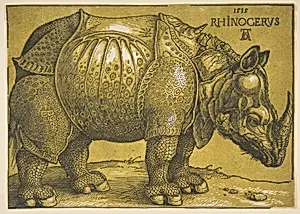
Medium
Chiaroscuro woodcut with tone block in printed in light olive green
Dimensions
sheet: 8 7/16 x 11 13/16 in. (21.4 x 30 cm)
Classification
Prints
Department
Drawings and Prints
Museum
Metropolitan Museum of Art, New York, NY
Credit
Rogers Fund, 1921
Accession Number
22.10.8
Rights
Public Domain
Tags
Art Historical Context
Behold *The Rhinoceros*, a chiaroscuro woodcut by Dutch publisher Willem Jansz Blaeu Albrecht Dürer’s iconic 1515 original. Produced after 1620, this measures 8 7/16 x 11 13/16 inches and captures the mythical allure of the exotic beast through meticulous line work and subtle tonality. Housed in the Metropolitan Museum of Art’s Drawings and Prints department (acquired via the Rogers Fund in 1921), it exemplifies the enduring fascination with rare animals in early modern Europe. The medium shines in its innovative chiaroscuro technique: a key block for outlines paired with a tone block printed in light olive green, evoking depth and volume akin to a drawing. This multi-block method, pioneered in the Renaissance, brought woodcuts closer to painting’s realism, making complex images accessible via printmaking’s reproducibility. Blaeu, a master cartographer, likely adapted Dürer’s design for scholarly atlases or natural history collections. Culturally, the rhinoceros symbolized wonder and the expanding world of discovery, its armored form a blend of fact and imagination that influenced maps and encyclopedias for centuries. This elegant print invites visitors to marvel at how art bridged distant continents and sparked scientific curiosity.