
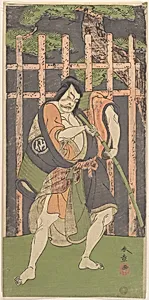
The Second Nakamura Sukegoro as an Outlaw
ca. 1771
Medium
Woodblock print (nishiki-e); ink and color on paper
Dimensions
12 1/8 x 5 7/8 in. (30.8 x 14.9 cm)
Classification
Prints
Culture & Period
Japan · Edo period (1615–1868)
Department
Asian Art
Museum
Metropolitan Museum of Art, New York, NY
Credit
Purchase, Joseph Pulitzer Bequest, 1918
Accession Number
JP415
Rights
Public Domain
Tags
Art Historical Context
In the lively world of Edo-period Japan (1615–1868), Katsukawa Shunshō's *The Second Nakamura Sukegoro as an Outlaw* (ca. 1771) captures the dramatic flair of kabuki theater. Shunshō, a leading figure in the ukiyo-e ("pictures of the floating world") tradition and founder of the Katsukawa school, specialized in yakusha-e—striking portraits of kabuki actors. Here, the celebrated onnagata (female impersonator) Nakamura Sukegoro II embodies a fierce outlaw, his expressive pose and costume frozen in a moment of theatrical intensity, blending realism with stylized exaggeration. This nishiki-e, or "brocade print," showcases the pinnacle of woodblock printing innovation. Artisans used multiple carved blocks inked in vibrant hues—up to a dozen colors—to achieve the luxurious, jewel-like effects that made these affordable prints wildly popular among urbanites in Edo (modern Tokyo). Measuring just 12⅛ × 5⅞ inches, it was designed for intimate appreciation, perhaps tucked into a kimono sleeve. As a window into Japan's theater-obsessed culture, the print highlights how stars like Sukegoro became cultural icons, their images fueling fan fervor akin to modern celebrities. Acquired by The Metropolitan Museum of Art in 1918, it exemplifies Shunshō's mastery in elevating everyday entertainment to high art.
About the Artist
Katsukawa Shunshō 勝川春章 (Japanese) · 1726 –1792
Japanese, 1726–1792