
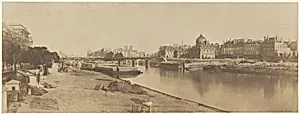
The Seine from the Pont du Carrousel Looking towards Notre Dame
1853
Medium
salted paper print
Dimensions
image/sheet: 15.8 × 42.7 cm (6 1/4 × 16 13/16 in.) mount: 28.2 × 55.2 cm (11 1/8 × 21 3/4 in.)
Classification
Photograph
Department
CPH
Museum
National Gallery of Art, Washington, D.C.
Credit
Patrons' Permanent Fund
Accession Number
1995.36.102
Rights
Public Domain
Art Historical Context
Step onto the Pont du Carrousel in1853 with Charles Marville's captivating *The Seine from the Pont durousel Looking Towards Notre Dame*. This salted paper print offers a panoramic vista along the River Seine, framing the iconic silhouette of Notre Dame Cathedral on the distant Île de la Cité. Marville, a pioneering French photographer later appointed as the official documentarian of Paris under Napoleon III, masterfully captures the city's pre-Haussmann bustle—barges dotting the water, bridges arching gracefully, and the medieval spires piercing a hazy sky. Printed via the salted paper process from a paper negative, this 15.8 × 42.7 cm image exemplifies early calotype photography's soft, luminous tones and subtle gradations, which lent an almost painterly quality to the medium. Unlike crisp modern prints, its delicate texture evokes the experimental spirit of 1850s photography, bridging art and documentation. Housed in the National Gallery of Art's photography collection through the Patrons' Permanent Fund, this work holds cultural treasure status. It preserves a vanishing Paris on the cusp of Baron Haussmann's transformative boulevards, inviting us to savor the Seine's timeless flow and Notre Dame's enduring majesty. A window to mid-19th-century life, it reminds us how photography forever etched urban poetry into history.
About the Artist
Charles Marville · 1813–1879
**Charles Marville**, born Charles François Bossu on July 17, 1813, in Paris, adopted his professional pseudonym around 1832 to avoid the stigma of "bossu," meaning hunchback in French. Trained as a painter, engraver, and illustrator, he spent nearly two decades producing woodblock illustrations for books and magazines before embracing photography around 1850. His transition coincided with the med...