
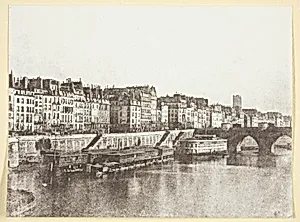
Le Pont-Neuf, les quais, les bains "A la Samaritaine" et la Tour St Jacques
1847, printed 1965
Medium
Gelatin silver print, No. 14 from the portfolio "Bayard: XXV Calotypes, 1842-1850" (1965)
Dimensions
Image/paper/mount: 17.2 × 23.1 cm (6 13/16 × 9 1/8 in.)
Classification
photographic process
Department
Photography and Media
Museum
Art Institute of Chicago
Accession Number
23788
Rights
Public Domain
Art Historical Context
Step into 19th-century Paris with Hippolyte Bayard's *Le Pont-Neuf, quais, les bains " la Samaritaine" la Tour St Jacques*1847, printed 1965), a early photograph that freezes the bustling heart of the city. Captured along the Seine, this gelatin silver print showcases iconic landmarks: the sturdy Pont-Neuf bridge, lively quays, the Samaritaine public baths, and the Gothic spire of Tour Saint-Jacques. Measuring a modest 17.2 × 23.1 cm, it's No. 14 from the 1965 portfolio *Bayard: XXV Calotypes, 1842-1850*, part of the Art Institute of Chicago's Photography and Media collection. Bayard, a French pioneer rivaling Louis Daguerre and William Henry Fox Talbot, embraced the calotype process—a paper-negative technique that produced textured, atmospheric images unlike the sharp daguerreotypes. Taken in 1847, this view reflects photography's infancy, documenting urban life with a soft, painterly quality born from the medium's limitations, like light-sensitive paper negatives. This print's cultural weight lies in its rarity: one of Bayard's few surviving calotypes, it bridges art and documentation, immortalizing Paris before Haussmann's transformations. A testament to early photographic innovation, it invites us to ponder how such humble sheets captured eternity, sparking photography's rise as both science and poetry.
About the Artist
Hippolyte Bayard · 1801–1887
Hippolyte Bayard (1801–1887) was a French civil servant and artist who holds a remarkable, if bittersweet, place in the history of photography: he was one of the independent inventors of the photographic process in the late 1830s, developing his own direct positive paper print method at virtually the same moment that Louis Daguerre and William Henry Fox Talbot were arriving at their own solutions ...