
The Sense of Hearing
16th century
Medium
Pen and brown ink, brush and brown wash. Touches of gray wash. Framing lines in pen and brown.
Dimensions
6 3/4 x 9 1/8 in. (17.1 x 23.1 cm)
Classification
Drawings
Department
Drawings and Prints
Museum
Metropolitan Museum of Art, New York, NY
Credit
The Elisha Whittelsey Collection, The Elisha Whittelsey Fund, 1954
Accession Number
54.648.4
Rights
Public Domain
Tags
Art Historical Context
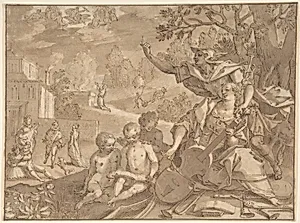
**The Sense of Hearing**, a exquisite 16th-century drawing attributed to Hans von Aachen and Joseph Heintz the Elder, captures the allegorical essence of one of the five senses through delicate mastery. Created with pen and brown ink, brush and brown wash, accented by touches of gray wash and framing lines, this intimate sheet measures just 6 3/4 x 9 1/8 inches. Housed in the Metropolitan Museum of Art's Drawings and Prints department as part of The Elisha Whittelsey Collection (1954), it exemplifies the refined techniques of late Renaissance draftsmen, where ink lines define form and washes evoke subtle shadows and atmosphere. The composition likely personifies Hearing amid a lively gathering of children, men, and women, with cellos prominently featured as symbols of musical harmony. Such allegories were popular in Northern Mannerist art, blending elegance with symbolic depth to explore human perception. Von Aachen, a key figure at the Prague court of Emperor Rudolf II, and Heintz, his contemporary, favored these fluid, expressive styles for preparatory studies that bridged painting and printmaking. This drawing's cultural resonance lies in its role within the tradition of the senses series, reflecting the era's fascination with sensory experience and the senses' moral or philosophical implications. Its meticulous technique highlights the artists' skill in conveying texture—from the curve of a cello string to the softness of fabric—inviting visitors to appreciate the preparatory artistry behind grand Mannerist visions.