
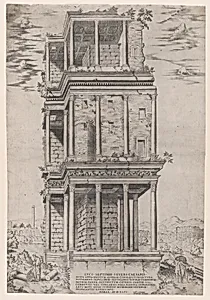
The Septizodium
Medium
Etching and engraving
Dimensions
sheet: 18 13/16 x 12 13/16 in. (47.8 x 32.5 cm)
Classification
Prints
Department
Drawings and Prints
Museum
Metropolitan Museum of Art, New York, NY
Credit
Purchase, Joseph Pulitzer Bequest, 1917
Accession Number
17.50.19-115
Rights
Public Domain
Tags
Art Historical Context
The Septizodium, captured in this 1556 etching and engraving, depicts the dramatic remains of an ancient Roman monument around 203 CE by Emperor Septimius Severus. Originally a grand, three-story façade adorned with seven niches for statues fountains, the structure stood near the Palatine Hill as a striking welcome to visitors entering Rome along the Appian Way. By the Renaissance, only fragments survived, and this print preserves its memory for a new audience fascinated by classical antiquity. Created by the publisher and engraver Antonio Lafreri (or a close associate), the work belongs to a celebrated series documenting Rome’s architectural heritage. Etching and engraving techniques allowed for precise architectural detail and atmospheric shading, making such images affordable and widely circulated. These prints played a vital role in the 16th-century revival of interest in ancient Rome, serving both scholars and travelers who could not visit the ruins themselves. Today housed in the Metropolitan Museum of Art, this sheet exemplifies how Renaissance artists bridged past and present, transforming crumbling monuments into enduring visual records that continue to educate and inspire.
About the Artist
Anonymous|Antonio Lafreri
In the vast tapestry of art history, "Anonymous" stands not as a singular individual but as a collective designation for countless unidentified creators whose works have endured across millennia. These artists, spanning prehistoric cave painters to medieval illuminators and folk craftsmen, produced the foundational layers of human visual culture. Prior to the Renaissance, when individual fame emer...