
The Slanderer
1851
Medium
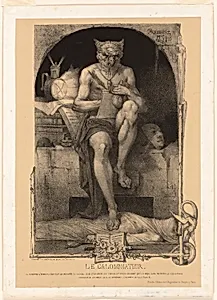
Lithograph, possibly from a zinc plate, or zincograph, in black crayon, pen and ink, scraping and tusche on tan wove paper laid, down on off-white wove paper
Dimensions
Image: 39.7 × 27.9 cm (15 11/16 × 11 in.); Primary support: 44.7 × 30.7 cm (17 5/8 × 12 1/8 in.); Secondary support: 48.2 × 34.8 cm (19 × 13 3/4 in.)
Classification
lithograph
Department
Prints and Drawings
Museum
Art Institute of Chicago
Accession Number
74147
Rights
Public Domain
Art Historical Context
"The Slanderer," created by Charles Rambert in 1851, is a striking lithograph that showcases the expressive potential of early printmaking techniques. Housed in the Art Institute of Chicago’s Prints and Drawings department, this work measures just under 16 by 11 inches in its image area. It was produced using a combination of black crayon, pen and ink, scraping, and tusche on tan wove paper, suggesting a layered approach that allowed for both bold lines and delicate tonal effects. Lithography in the mid-nineteenth century offered artists new freedom to create rich textures and spontaneous marks that could be reproduced for wider audiences. Rambert’s evident experimentation with zinc plates and varied drawing materials highlights the medium’s versatility, bridging the gap between original drawing and printed art. The title hints at a narrative or moral theme popular in that era, inviting viewers to consider the power of imagery in storytelling. This piece reflects the growing importance of prints as accessible art forms during the 1850s, when such works reached diverse viewers beyond traditional painting collectors. Its careful mounting on secondary supports further underscores the value placed on preserving these delicate impressions for study and appreciation today.