
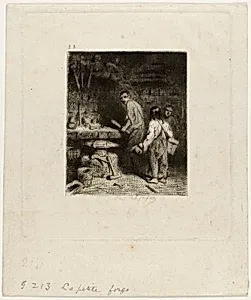
The Small Forge
Medium
Drypoint and roulette on ivory wove paper
Dimensions
Image: 5.7 × 4.7 cm (2 1/4 × 1 7/8 in.); Plate: 8.8 × 8 cm (3 1/2 × 3 3/16 in.); Sheet: 11.4 × 9.5 cm (4 1/2 × 3 3/4 in.)
Classification
etching
Department
Prints and Drawings
Museum
Art Institute of Chicago
Accession Number
45828
Rights
Public Domain
Art Historical Context
Charles Émile Jacque's *The Small Forge* (1843) captures the humble intensity of rural labor in a remarkably intimate print. A key figure in the Barbizon School, Jacque was renowned for his realistic depictions of peasant life and pastoral scenes, often infused with a keen eye for everyday drama. This work, executed in drypoint and roulette on wove paper, exemplifies mastery of printmaking during France's Romantic era, when artists sought authenticity in the countryside amid rapid industrialization. The tiny image measures just 5.7 × 4.7 cm, inviting close inspection to reveal the burr-rich lines of drypoint—created by scratching directly into the plate for velvety textures—and the roulette's dotted effects, which add atmospheric depth and sparkle to the forge's glow. Classified as an etching in the Art Institute of Chicago's Prints and Drawings collection, it highlights the medium's democratic appeal: affordable reproductions that brought fine art to broader audiences beyond oil paintings. Jacque's focus on the forge evokes the era's fascination with artisanal trades, blending technical precision with humanistic warmth. A gem for print enthusiasts, it underscores how 19th-century innovators like Jacque elevated the modest print to poetic heights.