
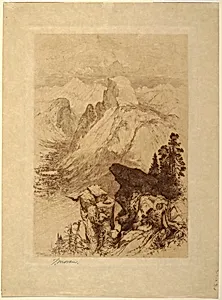
The South Dome, Yosemite Valley
Classification
landscapes
Department
Smithsonian Collection
Museum
Smithsonian American Art Museum
Credit
Museum purchase through gift of Mrs. Gustav E. Kissel
Accession Number
1949-102-2
Rights
Public Domain
About this artwork
Research in Progress
Art Historical Context
Thomas Moran's *The South Dome, Yosemite* (1887) captures the majestic grandeur of Yosemite's iconic granite formation—now famously known as Half Dome—in the heart of California's Sierra Nevada. Born in Britain and later a cornerstone of American art, Moran1837–1926) was a leading figure in the Hudson River, renowned for his luminous landscapes that romanticized the American West. This painting, now in the Smithsonian American Art through a generous museum purchase funded by Mrs. Gustav E. Kissel, exemplifies his lifelong passion for translating wilderness into art. Created during a pivotal era when Yosemite was already celebrated as a natural wonder—protected as a state grant in 1864 and soon to become a national park in 1890—Moran's work contributed to the growing national conservation movement. His vivid depictions influenced policymakers and the public, much like his earlier Yellowstone series that helped establish the world's first national park. Though the medium remains under research, Moran's signature style likely employs rich color and atmospheric light to evoke the sublime power of nature, drawing viewers into Yosemite's awe-inspiring scale. This landscape invites us to reflect on America's enduring bond with its wild places, blending artistic mastery with cultural advocacy. A timeless tribute to exploration and preservation.