
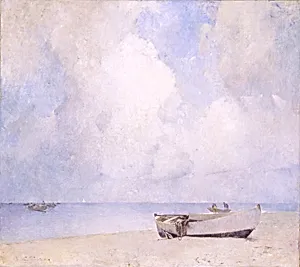
The South Strand
ca. 1909
Medium
Painting
Classification
Painting
Department
Smithsonian Collection
Museum
Smithsonian American Art Museum
Credit
Smithsonian American Art Museum, Gift of William T. Evans
Accession Number
1909.9.4
Rights
Public Domain
Tags
About this artwork
Emil Carlsen began painting landscapes around the turn of the twentieth century. He created a few scenes based on sketches he made in France, but most of his work depicted the countryside around his summer home in Connecticut. Carlsen admired French landscape artists who painted outdoors, and he emulated their simple scenes, emphasizing the color and atmosphere of the countryside.
Art Historical Context
Emil Carlsen's *The South Strand* (ca. 1909) captures a serene coastal scene, likely inspired by the beaches and countryside near his summer home in Connecticut Featuring a rowboat, figures on the shore, and drifting clouds over the water, the painting evokes the quiet beauty of the American coast at the turn of the twentieth century. As part of the Smithsonian American Art's collection, gifted by William T. Evans it reflects Carlsen's shift toward landscape painting around 1900, blending his Danish-American roots with European influences. Carlsen admired French artists who painted en plein air—outdoors—to seize fleeting natural light. Though he sketched some scenes in France, most of his works, like this one, drew from familiar New England locales. He emulated their approach with simple compositions that prioritize color and atmosphere over intricate detail, creating a harmonious mood that invites viewers to linger. This oil painting exemplifies Carlsen's tonal style, where subtle hues of sea, sky, and sand build a poetic sense of place. For museum-goers, it offers a window into early 20th-century American art's embrace of impressionistic techniques, celebrating the everyday poetry of the shoreline.