
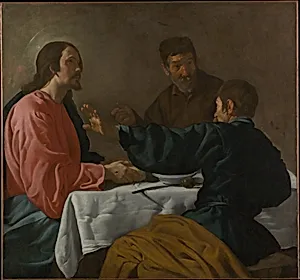
The Supper at Emmaus
Medium
Oil on canvas
Dimensions
48 1/2 x 52 1/4 in. (123.2 x 132.7 cm)
Classification
Paintings
Department
European Paintings
Museum
Metropolitan Museum of Art, New York, NY
Credit
Bequest of Benjamin Altman, 1913
Accession Number
14.40.631
Rights
Public Domain
Tags
Art Historical Context
Diego Velázquez's *The Supper at Emma* (1622–23), an oil on canvas measuring 48½ × 52¼ inches, captures a pivotal biblical moment from the Gospel of Luke. Here, the resurrected Christ reveals himself to two disciples during a humble supper in the village of Emmaus. Painted during Velázquez's early career in Seville this work reflects the Spanish Baroque master's emerging genius for realism and dramatic storytelling, drawing from Caravaggio's tenebrism—the bold interplay of light and shadow that heightens emotional intensity. Velázquez, at just 23 years old, masterfully renders the figures' textures—from the coarse bread and worn fabrics to the disciples' astonished expressions—using rich oil glazes that convey both spiritual mystery and everyday intimacy. This technique underscores the Counter-Reformation's emphasis on relatable religious scenes, making divine encounters feel immediate and human. Now housed in the Metropolitan Museum of Art's European Paintings department (Bequest of Benjamin Altman, 1913), the painting exemplifies Velázquez's transition from tenebrist influences to his lifelong pursuit of naturalism. Visitors are drawn to its quiet power, inviting reflection on faith's quiet revelations amid ordinary meals.
About the Artist
Velázquez (Diego Rodríguez de Silva y Velázquez) · 1599–1660
Diego Rodríguez de Silva y Velázquez, baptized on June 6, 1599, in Seville, Spain, emerged as one of the supreme masters of the Spanish Baroque. The eldest son of notary Juan Rodríguez de Silva and Jerónima Velázquez, he displayed prodigious talent early on. At around age 11 or 12, he apprenticed under Francisco Pacheco, the esteemed Sevillian painter, theorist, and writer whose studio functioned ...