
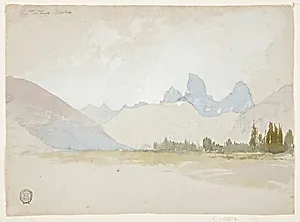
The Tetons, Idaho
Classification
landscapes
Department
Smithsonian Collection
Museum
Smithsonian American Art Museum
Credit
Gift of Thomas Moran
Accession Number
1917-17-33
Rights
Public Domain
About this artwork
Research in Progress
Art Historical Context
Thomas Moran's *The Tetons, Idaho* (1879) captures the majestic grandeur of the American West during a transformative era of exploration and expansion. Born in Britain in 1837 and later becoming a defining American artist, Moran was leading figure in the Hudson River, renowned for his luminous landscapes that romanticized the untamed wilderness. This painting, now in the Smithsonian American Art Museum's Smithsonian Collection, reflects his passion for depicting the Rocky Mountains, particularly after his expeditions with government surveys in the 1870s that helped promote the creation of Yellowstone National Park. As a gifted landscape from Moran's own donation to the museum, the work exemplifies his mastery in evoking the sublime power of nature—towering peaks piercing dramatic skies, rendered with a poetic realism that stirred national pride. Though the medium remains under research, Moran's typical use of oil on canvas allowed for rich textures and glowing light effects, hallmarks of his style influenced by European Romanticism and American Luminism. Painted just two years after his Yellowstone travels, it underscores the cultural shift toward preserving America's natural wonders amid rapid settlement. Visitors will appreciate how Moran's vision not only documented the Tetons—straddling what was then seen as Idaho territory—but also fueled the conservation movement, making this piece a window into 19th-century America's evolving relationship with its wild frontiers.