
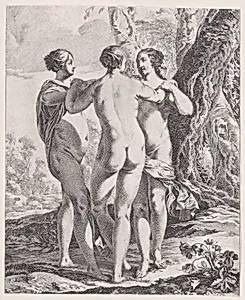
The Three Graces
ca. 1628–76
Medium
Etching
Dimensions
Sheet (Trimmed): 9 15/16 × 8 1/8 in. (25.3 × 20.7 cm)
Classification
Prints
Department
Drawings and Prints
Museum
Metropolitan Museum of Art, New York, NY
Credit
Purchase, Joseph Pulitzer Bequest, 1917
Accession Number
17.50.15–75
Rights
Public Domain
Art Historical Context
Behold *The Three Graces*, delicate etching created by French artists Laurent de La Hyre François Chauveau around1628–76. This print captures the timeless mythological trio—Aglaea, Euphrosyne, and Th—symbols of beauty, charm, and creativity from classical antiquity. De La Hyre, a painter known for his elegant classicism within the Baroque era, likely contributed the graceful design, while Chauve, a skilled engraver, brought it to life through printmaking. Together, they evoke the harmonious ideals of 17th-century French art, blending mythological reverence with refined elegance. Etching, the medium here, was a revolutionary intaglio technique: artists drew lines into a wax-coated metal plate, which acid etched to create precise, expressive grooves for inking and printing. At 9 15/16 × 8 1/8 inches (trimmed), this intimate sheet allowed for widespread dissemination of sophisticated imagery, making classical themes accessible beyond elite patrons. Acquired in 1917 through the Joseph Pulitzer Bequest, it resides in the Metropolitan Museum of Art's Drawings and Prints department. This work highlights the era's fascination with antiquity, showcasing how prints preserved and popularized beauty's eternal dance for generations of admirers.
About the Artist
Laurent de La Hyre|François Chauveau · 1606–1656
Laurent de La Hyre (1606–1656) was a French painter whose elegant, classical compositions placed him among the finest artists of the first generation of French Baroque painters working in Paris. Born into an artistic family — his father Étienne de La Hyre was also a painter — Laurent received his early training largely through independent study rather than formal apprenticeship under a single domi...