
The Three Trees
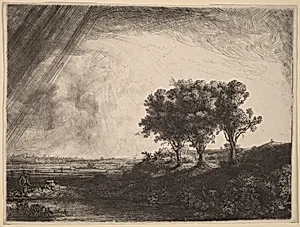
Medium
etching with drypoint and engraving on laid paper
Dimensions
plate: 21.4 x 28 cm (8 7/16 x 11 in.) sheet: 21.8 x 28.7 cm (8 9/16 x 11 5/16 in.)
Classification
Department
CG-E
Museum
National Gallery of Art, Washington, D.C.
Credit
Rosenwald Collection
Accession Number
1943.3.9119
Rights
Public Domain
Art Historical Context
Rembrandt van Rijn'sThe Three Trees* (1643) stands as a pinnacle of 17th-century Dutch printmaking, capturing the raw power of nature in a dramatic landscape etching. Created during the Dutch Golden Age when Rembrandt was at the height of his career in Amsterdam, this work showcases his innovative mastery of the process. The plate measures 21.4 x 28 cm, making it one of his largest pure landscapes, rendered on laid paper with a striking sense of immediacy and atmosphere. What elevates this print is Rembrandt's virtuoso blend of etching, drypoint, and engraving techniques. Etching allowed fluid, spontaneous lines to evoke wind-swept branches and distant horizons, while drypoint's soft burr created velvety textures and deep shadows, mimicking the richness of oil paint. Engraving added precise details for clarity. This technical fusion not only pushed the boundaries of printmaking but also democratized Rembrandt's genius, as multiples could be shared widely—unlike his exclusive paintings. Housed in the National Gallery of Art's Rosenwald Collection, *The Three Trees* exemplifies Rembrandt's ability to infuse everyday scenery with profound emotional depth, influencing generations of artists. Visitors will marvel at how three solitary trees dominate the stormy sky, symbolizing resilience amid nature's fury—a timeless meditation on light, form, and the sublime.
About the Artist
Rembrandt van Rijn · 1606–1669
Rembrandt Harmenszoon van Rijn (1606–1669) stands as one of the greatest visual artists in the history of Western art and the most important Dutch painter of the 17th century. Born in Leiden to a prosperous miller's family, Rembrandt transformed painting through his revolutionary use of light and shadow, his psychological depth in portraiture, and his elevation of etching to a fine art. His approx...