
The Triumph of Venus
16th century
Medium
pen and brown ink
Dimensions
overall: 16.9 x 66.2 cm (6 5/8 x 26 1/16 in.)
Classification
Drawing
Department
CG-E
Museum
National Gallery of Art, Washington, D.C.
Credit
Julius S. Held Collection
Accession Number
1985.1.7
Rights
Public Domain
Art Historical Context
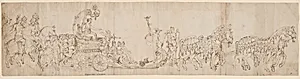
Behold *The Triumph of Venus*, a captivating 16th-century drawing the Italian school, now housed in the National Gallery of as part of the Julius S Held Collection. This elongated pen and brown ink work (16.9 x 66.2 cm) evokes the grandeur of classical mythology, depicting a procession honoring Venus, the Roman goddess of love and beauty Such themes were immensely popular during the Renaissance, as artists drew inspiration from ancient texts like those of Ovid, blending pagan revelry with humanist ideals of harmony and sensuality. Crafted in the precise medium of pen and brown ink, the piece showcases the technical virtuosity of Italian draughtsmen from this era. Brown ink, often derived from oak galls, allowed for fluid line work, intricate cross-hatching, and subtle tonal modeling—techniques essential for preparatory sketches or autonomous collector's items. Its panoramic format suggests a frieze-like composition, mirroring ancient Roman reliefs and reflecting the 16th-century fascination with antiquity amid the flourishing of Mannerist styles in Italy. As an anonymous yet masterful example from the High Renaissance transition, this drawing highlights the era's emphasis on disegno (drawing) as the foundation of art. Visitors will appreciate its delicate energy, a window into the creative processes of masters like those in the Fontainebleau school or Veronese's circle, inviting contemplation of love's triumphant procession through time.
About the Artist
Italian 16th Century · 1500–1599
"Italian 16th Century" refers to a collective attribution for anonymous painters and sculptors active in Italy during the 16th century, a period bridging the High Renaissance and Mannerism. These artists, often working in workshops of masters like Titian, Veronese, and Tintoretto, remain unidentified due to the collaborative nature of Renaissance production. Their early lives and training are not ...