
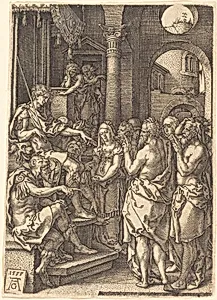
The Two Elders Before the Judge
Medium
etching
Classification
Department
CG-E
Museum
National Gallery of Art, Washington, D.C.
Credit
Rosenwald Collection
Accession Number
1943.3.224
Rights
Public Domain
Art Historical Context
In the National Gallery of Art's Rosen Collection, Heinrich Aldegrever's *The Two Elders Before the Judge* (1555) captures a tense biblical drama from the Book of Daniel This etching depicts the moment when two lecherous elders, who falsely accused the virtuous Susanna of adultery, stand trial before a wise judge—likely the young prophet Daniel himself. Aldegrever, a German printmaker of the Renaissance known as one of the "Little Masters for his intricate small-scale works, drew from this apocryphal story to explore themes of justice, morality, and divine intervention, resonating deeply in the Reformation-era Germany of the mid-16th century. As an etching, a technique Aldegrever helped popularize alongside engraving, the print features fluid, expressive lines that convey the elders' guilt and the judge's authority with remarkable detail in a compact format—typically just a few inches across. This medium allowed artists like Aldegrever, who trained as a goldsmith in Soest, to produce affordable multiples, spreading religious narratives to a wide audience beyond elite patrons. Aldegrever's precise style, influenced by Albrecht Dürer, blends Northern Renaissance realism with moral allegory, making this work a fine example of how prints democratized art and reinforced ethical lessons during a time of religious upheaval. Visitors will appreciate its narrative intensity and technical finesse.
About the Artist
Heinrich Aldegrever · 1502–1561
Heinrich Aldegrever, born in 1502 in Paderborn, Westphalia, to parents Herman and Katherine Trippenmeker—a family of clog-makers known by the dialect name Trippenmecker—emerged as a multifaceted artist in the German Renaissance. His early training remains undocumented, though he likely apprenticed in a Soest goldsmith's workshop after relocating there around 1525, where he joined the painters' gui...