
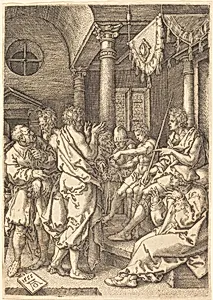
The Two Elders Convicted by the Testimony of Daniel
Medium
etching
Classification
Department
CG-E
Museum
National Gallery of Art, Washington, D.C.
Credit
Rosenwald Collection
Accession Number
1943.3.225
Rights
Public Domain
Art Historical Context
In the National Gallery of Art's Rosenwald Collection, Heinrich Aldegrever's 1555 etching *The Elders Convicted by the of Daniel* captures a dramatic biblical moment from the Book of Daniel. The scene depicts the judgment of the two lecherous elders who falsely accused the virtuous Susanna, only to be exposed by the young prophet Daniel's shrewd cross-examination. Aldegrever, a prominent German printmaker of the Northern Renaissance and one of the "Little Masters known for their intricate small-scale works, renders the figures with expressive intensity, their guilty expressions contrasting Daniel's righteous authority. Created during the Protestant Reformation, when religious imagery was hotly debated, this print reflects Aldegrever's Protestant leanings and his skill in disseminating moral tales through affordable etchings. Etching, a relatively new technique in the mid-16th century, allowed Aldegrever freer, more spontaneous lines than traditional engraving, enabling detailed textures in clothing and faces that draw viewers into the narrative tension. This work exemplifies the era's fusion of faith, justice, and artistry, making complex theology accessible. Aldegrever produced over 200 prints, blending Italian influences with Northern precision, and this piece stands as a testament to prints' role in shaping public devotion and discourse.
About the Artist
Heinrich Aldegrever · 1502–1561
Heinrich Aldegrever, born in 1502 in Paderborn, Westphalia, to parents Herman and Katherine Trippenmeker—a family of clog-makers known by the dialect name Trippenmecker—emerged as a multifaceted artist in the German Renaissance. His early training remains undocumented, though he likely apprenticed in a Soest goldsmith's workshop after relocating there around 1525, where he joined the painters' gui...