
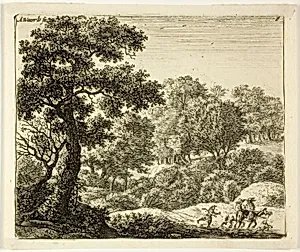
The Two Horsemen
Medium
Etching on paper
Dimensions
Image: 11.8 × 14.1 cm (4 11/16 × 5 9/16 in.); Plate: 11.9 × 14.2 cm (4 11/16 × 5 5/8 in.); Sheet: 12.9 × 15.3 cm (5 1/8 × 6 1/16 in.)
Classification
etching
Department
Prints and Drawings
Museum
Art Institute of Chicago
Accession Number
109086
Rights
Public Domain
Art Historical Context
Anthonie Waterloo's *The Two Horsemen* a delicate etching on paper, capturing two riders amid a natural landscape in a compact image measuring just 11.8 × 14.1 cm. Created during the Dutch Golden Age (undated, but likely mid-17th century), print exemplifies Waterloo's mastery as a landscapist and etcher. Born around 1609 in the Netherlands, Waterloo was renowned for his intricate etchings that blended detailed foliage, atmospheric depth, and subtle figures, drawing from the realist traditions of artists like Rembrandt and the van Ruisdael family. Etching, Waterloo's preferred medium, involved biting acid into a metal plate to create fine, expressive lines—ideal for evoking the textured bark, distant hills, and moody skies of the Dutch countryside. This technique allowed for affordable, reproducible artworks that appealed to collectors across Europe, making landscape prints a cultural phenomenon during a time of prosperity and exploration. Housed in the Art Institute of Chicago's Prints and Drawings department, *The Two Horsemen* invites viewers to appreciate the quiet drama of everyday travelers in nature. Its small scale belies its technical precision, offering a window into 17th-century printmaking's artistry and the era's fascination with the sublime outdoors. A gem for print enthusiasts! (198 words)
About the Artist
Anthonie Waterloo · 1609–1690
Anthonie Waterloo (1609–1690) was a prominent Dutch Golden Age landscape artist, born on May 6 in Lille, then part of the Spanish Netherlands. Little is known of his early life beyond his mother, Magdalena Vaillant, who joined Amsterdam's Walloon Church in 1621, with Waterloo following in 1630; no records exist of formal training, and he was likely self-taught. Registered as a painter in Amsterdam...