
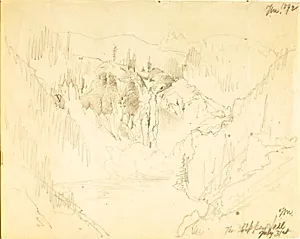
The Upper Fall
1892
Medium
Drawing
Classification
Drawing
Department
Smithsonian Collection
Museum
Smithsonian American Art Museum
Credit
Smithsonian American Art Museum, Gift of Dr. William Henry Holmes
Accession Number
1947.13.35
Rights
Public Domain
Tags
Art Historical Context
Thomas Moran's *The Upper Fall* (1892) is a captivating drawing that immortalizes the dramatic beauty of Yellowstone National Park's Upper Falls along the Yellowstone River. Nestled in the rugged Rocky Mountains of Wyoming, this artwork captures the thundering cascade in a moment of raw natural power, showcasing Moran's lifelong passion for the American West. As a leading figure in the Hudson River School and a pioneering artist-explorer, Moran traveled extensively to document these wilderness wonders, blending romanticism with precise observation. Created as a drawing, this piece highlights Moran's masterful use of line, tone, and subtle shading to convey depth, mist, and light—techniques that often served as studies for his grand oil paintings. His luminous depictions played a pivotal role in the conservation movement; Moran's earlier Yellowstone sketches helped convince Congress to establish the world's first national park in 1872. This 1892 work reflects his enduring commitment to celebrating America's untamed landscapes. Today, *The Upper Fall* graces the Smithsonian American Art Museum, a gift from Dr. William Henry Holmes, inviting visitors to ponder the timeless allure of nature's grandeur preserved on paper.
About the Artist
Thomas Moran · 1837–1926
Thomas Moran (1837–1926) was an American painter and printmaker of the Hudson River School whose dramatic paintings of the American West played a pivotal role in the creation of the national parks. Born in Bolton, Lancashire, England, he emigrated with his family to Philadelphia as a child. He was largely self-taught, though he apprenticed briefly with a wood engraver and studied the work of J.M.W...