
The Vampire (Vampyr)
1895
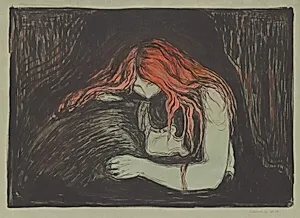
Medium
lithograph with watercolor
Dimensions
image: 38 x 54.6 cm (14 15/16 x 21 1/2 in.) sheet: 45.3 x 58.9 cm (17 13/16 x 23 3/16 in.)
Classification
Department
CG-E
Museum
National Gallery of Art, Washington, D.C.
Credit
Rosenwald Collection
Accession Number
1950.17.210
Rights
Public Domain
Art Historical Context
Edvard Munch's *The Vampire (Vamp)*, created in 1895, is a haunting lithograph enhanced with watercolor, measuring 38 x 54.6 cm. This print captures the Norwegian artist's fascination with themes of love, death, and existential dread, hallmarks of his Symbolist and proto-Expressionist style. Munch produced it during a prolific period in Berlin, amid personal turmoil including the death of his mother and sister, which infused his work with raw emotional intensity. The medium of lithography allowed Munch to experiment with mass production while retaining hand-applied watercolor for vivid, atmospheric effects—here, the blood-red gown of the female figure dominates, symbolizing a life-draining seductress leaning over a prone man. Often misinterpreted as a literal vampire, it reflects fin-de-siècle anxieties about female sexuality and mortality, echoing Munch's broader "Frieze of Life" series alongside icons like *The Scream*. Housed in the National Gallery of Art's Rosenwald Collection, this work exemplifies Munch's innovative printmaking, bridging painting and graphic art. Its cultural resonance endures, inviting viewers to confront the shadowy boundaries between desire and destruction in a single, mesmerizing image.
About the Artist
Edvard Munch · 1863–1944
Edvard Munch (1863-1944) was a Norwegian painter and printmaker whose intensely psychological works made him a pioneer of Expressionism and one of the most influential artists of the modern era. His 1893 masterpiece 'The Scream' has become an iconic symbol of existential anxiety. Munch's art was profoundly shaped by personal tragedy—his mother died when he was five, his beloved sister Sophie at fo...