
The Vase of Tulips
c. 1890
Medium
Oil on canvas
Dimensions
59.6 × 42.3 cm (23 1/2 × 16 5/8 in.); Framed: 84.5 × 67 × 10.2 cm (33 1/4 × 26 3/8 × 4 in.)
Classification
oil on canvas
Department
Painting and Sculpture of Europe
Museum
Art Institute of Chicago
Accession Number
14561
Rights
Public Domain
About this artwork
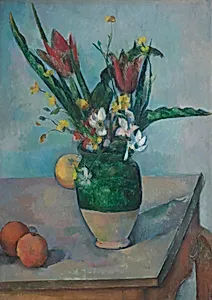
The table in this still life of flowers and fruit appears in several of Paul Cezanne’s other paintings, although scholars do not agree about which of the artist’s residences housed this piece of furniture. As is typical of Cezanne’s work, the painting is carefully considered and the composition hard won: the traces of at least three other pieces of fruit (presumably oranges) at lower left and near the vase attest to the artist’s changing opinion as he struggled to make the arrangement work. Even...
Art Historical Context
Paul Cézanne's *The Vase of Tulips*, painted around 1890, captures a simple yet profound still life: vibrant tulips bursting from a vase against a subtly modulated background. This oil on canvas, measuring about 60 x 42 cm, exemplifies Cézanne's mature period at his Aix-en-Provence studio, where he obsessively explored everyday objects to redefine painting itself. As a cornerstone of Post-Impressionism, Cézanne moved beyond Impressionist fleeting light, constructing solid forms through deliberate brushwork and color planes. Cézanne's technique here—layered, mosaic-like strokes—builds volume and depth, treating the canvas as a geometric structure rather than mere illusion. Tulips, symbols of Dutch opulence in earlier art, become vehicles for his revolutionary vision, influencing Picasso and the Cubists by emphasizing the picture plane's two-dimensionality. This intimate work reveals his quest for permanence amid change, bridging 19th-century tradition with modern abstraction. Housed in the Art Institute of Chicago's Department of Painting and Sculpture of Europe, *The Vase of Tulips* invites visitors to linger, appreciating how Cézanne transformed the ordinary into timeless art. A quiet masterpiece amid his prolific still lifes, it underscores his legacy as the "father of modern painting."
About the Artist
Paul Cezanne · 1839–1906
Paul Cézanne (1839–1906), born in Aix-en-Provence to a prosperous banker father, Louis-Auguste, and mother Anne-Elisabeth-Honorine Aubert, grew up in a bourgeois family that later acquired the Jas de Bouffan estate, where he painted his earliest murals. As a youth, he formed the inseparable trio "Les Trois Inséparables" with schoolmates Émile Zola and Baptistin Baille. Despite his father's wishes ...