
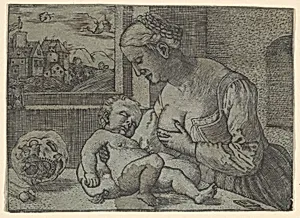
The Virgin and Child with the Skull (copy)
16th century
Medium
Engraving printed on blue paper
Dimensions
Sheet: 2 3/4 x 3 7/8 in. (7 x 9.8 cm)
Classification
Prints
Department
Drawings and Prints
Museum
Metropolitan Museum of Art, New York, NY
Credit
Gift of Harry G. Friedman, 1962
Accession Number
57.658.35
Rights
Public Domain
Tags
Art Historical Context
In the intimate engraving *The Virgin and Child with Skull (copy)*, attributed to Barthel Beham with possible involvement by Nikolaus Wilborn the tender Madonna cradles the Christ Child while contemplating a skull—a poignant 16th-century fusion of and mortality. Created during the Northern Renaissance, this small print (just 2¾ x 3⅞ inches) exemplifies the era's fascination with *memento mori*, where symbols of death like the skull remind viewers of life's transience, even in sacred scenes of divine motherhood. Beham, a masterful German engraver known for his precise, jewel-like prints, likely inspired this work, blending religious iconography with vanitas motifs popular in Protestant Reformation circles. Printed on rare blue paper, the medium creates a moody, atmospheric tone, enhancing the skull's shadowy presence against the figures' soft contours—a technique that mimicked colored grounds in paintings and made such prints collector's treasures. Housed in the Metropolitan Museum of Art's Drawings and Prints department (gift of Harry G. Friedman, 1962), this copy invites reflection on faith, fragility, and artistry. Its diminutive scale suited private contemplation, much like a Renaissance prayer book illumination, bridging the spiritual and the starkly human.
About the Artist
Barthel Beham|Nikolaus Wilborn · 1502–1540
Barthel Beham (1502–1540), a pivotal figure in the German Renaissance, was born in Nuremberg into a family of artists. The younger brother of the renowned engraver Hans Sebald Beham, he honed his craft under the tutelage of his elder sibling and the master Albrecht Dürer, absorbing the precise techniques of engraving and painting that defined Nuremberg's vibrant artistic scene. Emerging as a prodi...