
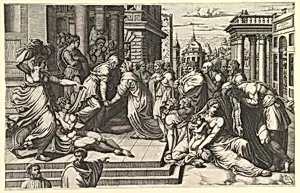
The Visitation
Medium
Engraving; second state of six (BLL)
Dimensions
Sheet (Trimmed): 12 11/16 × 19 1/2 in. (32.3 × 49.5 cm)
Classification
Prints
Department
Drawings and Prints
Museum
Metropolitan Museum of Art, New York, NY
Credit
The Elisha Whittelsey Collection, The Elisha Whittelsey Fund, 1949
Accession Number
49.95.2319
Rights
Public Domain
Tags
Art Historical Context
Behold *The Visitation*, a engraving created around 1540–50 by the renowned Italian engraver Giorgio Ghisi after a design by Mannerist painter Francesco Salvi (Francesco de' Rossi This second state of six captures the biblical scene from the Gospel of Luke, where the Virgin Mary visits her cousin Elizabeth, both radiant with divine joy amid attendants, children, men, and women. Salviati's elegant, elongated figures and dynamic compositions reflect the sophisticated Mannerism of mid-16th-century Italy, bridging Renaissance harmony with emerging stylistic grace. Engravings like this were revolutionary reproductive prints, allowing Salviati's inventive designs—known for their intricate narratives and emotional depth—to reach a wide audience across Europe. Ghisi's precise burin work on the copper plate produces rich tonal contrasts and fine details, evident in the trimmed sheet's generous 12 11/16 × 19 1/2 in. format. As part of the Metropolitan Museum of Art's Elisha Whittelsey Collection, it exemplifies the era's printmaking boom, blending religious devotion with artistic virtuosity. This poignant work invites reflection on themes of faith, family, and femininity, offering visitors a window into Renaissance devotion made accessible through technical innovation.
About the Artist
Giorgio Ghisi|Francesco Salviati (Francesco de' Rossi) · 1520–1582
Giorgio Ghisi (c. 1520–1582) was one of the most accomplished engravers of the Italian Renaissance, renowned for translating the monumental compositions of Raphael, Giulio Romano, and Michelangelo into the exacting medium of the burin. Born in Mantua, he trained in an environment shaped by the legacy of Giulio Romano's decoration of the Palazzo del Te, and the grandeur of that Mannerist tradition ...