
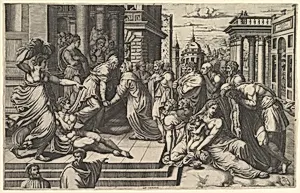
The Visitation
Medium
Engraving; third state of six (BLL)
Dimensions
Sheet (Trimmed): 12 5/8 × 19 11/16 in. (32 × 50 cm)
Classification
Prints
Department
Drawings and Prints
Museum
Metropolitan Museum of Art, New York, NY
Credit
The Elisha Whittelsey Collection, The Elisha Whittelsey Fund, 1949
Accession Number
49.97.463
Rights
Public Domain
Tags
Art Historical Context
### The Visitation Behold *The Visitation*, a 16th-century engraving the biblical encounter between the Virgin Mary and her cousin Elizabeth, as described in the Gospel of Luke. Created between 1540 and 1550, this print is a collaborative triumph: designed by the Mannerist painter Francesco Salati (Francesco de'), engraved by the virtuoso Giorgio Ghisi, and by Antonio Lafreri. Salviati's elegant, elongated figures and dynamic compositions reflect the sophisticated Mannerist style emerging in mid-Renaissance Italy, bridging classical harmony with expressive distortion. Measuring a generous 12⅝ × 19⅖ inches (trimmed), this third state of six showcases the precision of engraving—a burin-cut technique on copper plates that allowed for intricate details and tonal depth. Such prints were revolutionary, enabling artists' designs to reach collectors across Europe far beyond original paintings, democratizing high art. Housed in the Metropolitan Museum of Art's Drawings and Prints department (acquired via The Elisha Whittelsey Fund in 1949), *The Visitation* highlights the era's devotion to religious themes amid the Catholic Reformation. Its tags—men and women—evoke the intimate humanity of the scene, inviting visitors to ponder faith, family, and artistic innovation in Renaissance printmaking.
About the Artist
Antonio Lafreri|Giorgio Ghisi|Francesco Salviati (Francesco de' Rossi) · 1507–1577
Antonio Lafreri, born Antoine du Pérac Lafréry around 1512 in Orgelet in the County of Burgundy (modern-day France), emerged as one of the most influential print publishers of the 16th century after settling in Rome around 1540. His early life and training remain sparsely documented, with no records of specific teachers or art schools; he arrived in the Eternal City as an engraver, producing works...