
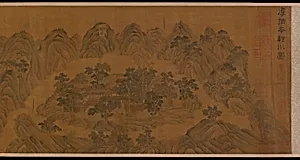
The Wangchuan Villa
Classification
Painting
Department
Smithsonian Collection
Museum
Smithsonian American Art Museum
Credit
Gift of Charles Lang Freer
Accession Number
F1911.205
Rights
Public Domain
Tags
About this artwork
Wangchuan Villa was the famous garden estate of the poet-painter Wang Wei (ca. 699-ca.761), who acquired the property around 740. Wang wrote twenty quatrains describing points of interest in the garden, and he illustrated the poetic mood of each site in a painting that ultimately became one of the most revered landscape scrolls in Chinese history. The composition provides a journey through a spectacular garden filled with sites designed to encourage quiet contemplation and at the same time suita...
Art Historical Context
**The Wangchuan Villa** Step into the serene world of ancient Chinese landscape painting with *The Wangchuan Villa*, a captivating scroll traditionally attributed to the Song dynasty artist Guo Zhongshu (910–977), though this 17th-century version hails from the Ming or Qing dynasty. It recreates the legendary garden estate of the Tang poet-painter Wang Wei (ca. 699–ca. 761), acquired around 740 CE near the Wei River in modern-day Shanxi Province. Wang Wei, a master of blending poetry and art, composed twenty quatrains evoking the moods of key sites—from misty mountains to tranquil pavilions—pairing them with illustrations that birthed one of China's most revered landscape scrolls. This handscroll unfolds like a poetic journey, guiding viewers through a meticulously designed garden that balanced quiet contemplation with elegant entertaining. Each scene captures the harmonious interplay of nature and human ingenuity, embodying the Chinese ideal of *shan shui* (mountain-water) painting, where vast, ethereal landscapes evoke spiritual introspection. As part of Charles Lang Freer's renowned gift to the Smithsonian American Art Museum, it highlights the enduring cultural reverence for Wang Wei's vision, influencing generations of artists across dynasties. (198 words)