
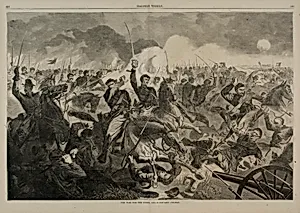
The War for the Union 1862--A Cavalry Charge, from Harper's Weekly, July 5, 1862
1862
Medium
Graphic Arts-Print
Classification
Graphic Arts-Print
Department
Smithsonian Collection
Museum
Smithsonian American Art Museum
Credit
Smithsonian American Art Museum, The Ray Austrian Collection, Gift of Beatrice L. Austrian, Caryl A. Austrian and James A. Austrian
Accession Number
1996.63.118
Rights
Public Domain
Tags
Art Historical Context
Winslow Homer's *The War for the Union1862--A Cavalry*, published in *Harper's Weekly* on 5, 1862, captures the raw intensity of the American Civil War As a young artist and special correspondent for the popular illustrated newspaper, Homer sketched scenes directly from the front lines near Washington, D.C., translating his observations into dynamic wood engravings. This print exemplifies his early career, where he honed a realist style that would define his later paintings, emphasizing the heroism and chaos of conflict. The image depicts a dramatic Union cavalry charge, with mounted soldiers in mid-gallop, evoking the thunder of hooves and clash of sabers amid the fight for national unity. *Harper's Weekly*, a key source of visual news for Northern audiences, disseminated such prints to millions, shaping public perception of the war's stakes. Homer's precise lines and sense of motion highlight the equestrian prowess and human cost of battle, making this a poignant artifact of 1862's pivotal struggles. Housed in the Smithsonian American Art Museum's Ray Austrian Collection, this graphic arts print underscores Homer's role in documenting history, bridging journalism and fine art. Visitors will appreciate its immediacy—a window into the Civil War's fervor that feels vividly alive even today.
About the Artist
Winslow Homer · 1836–1910
Winslow Homer (1836-1910) was one of America's greatest painters and a preeminent figure in 19th-century American art. Largely self-taught, Homer began his career as a commercial illustrator and Civil War correspondent for Harper's Weekly before becoming renowned for his powerful marine subjects and landscape paintings. His mastery of both oil and watercolor, combined with his uncompromising reali...