
The Washerwomen (Les laveuses)
1889, published after 1900
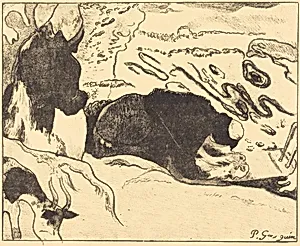
Medium
lithograph (zinc) on imitation Japan paper
Dimensions
image: 21.3 × 26.5 cm (8 3/8 × 10 7/16 in.) sheet: 32.2 × 47 cm (12 11/16 × 18 1/2 in.)
Classification
Department
CG-E
Museum
National Gallery of Art, Washington, D.C.
Credit
Rosenwald Collection
Accession Number
1963.11.100
Rights
Public Domain
Art Historical Context
Paul Gauguin's *The Washerwomen (Les laveuses)*, in 1889 and published after 1900, the everyday labor of Breton women along a riverbank. This lithograph on zinc, printed on imitation Japan paper, measures a modest 21.3 × 26.5 cm for the image, inviting intimate contemplation. Gauguin, a pioneering Post-Impressionist, drew from his time in rural Brittany, France, where sought to escape modern industrial life for primal, folk subjects. His bold, flattened forms and vibrant patterns reflect the Synthetist style he developed with Émile Bernard, emphasizing emotion over realism. The choice of lithography—a planographic printing technique using greasy crayons on zinc plates—allowed Gauguin to achieve rich tonal variations and textures, mimicking the absorbent quality of genuine Japanese paper. This medium democratized his vision, making it reproducible and affordable beyond elite painting circles. Imitation Japan paper enhanced the print's subtle gradations, evoking Eastern influences that Gauguin admired amid his growing fascination with non-Western art. Housed in the National Gallery of Art's Rosenwald Collection (Department CG-E), this work exemplifies Gauguin's bridge between European tradition and exotic ideals, foreshadowing his later Tahitian sojourns. A poignant snapshot of 19th-century rural life, it reminds us of art's power to elevate the ordinary.
About the Artist
Paul Gauguin · 1848–1903
Paul Gauguin (1848-1903) was a French Post-Impressionist painter whose bold experiments with color, form, and subject matter made him one of the most influential figures in the transition from 19th-century art to modernism. His rejection of European civilization for the perceived authenticity of 'primitive' cultures established an archetype of artistic exile that continues to resonate. Gauguin's ...