
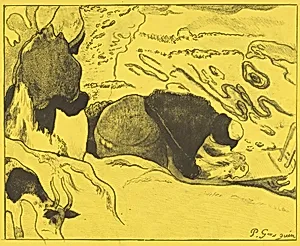
The Washerwomen (Les laveuses)
1889
Medium
lithograph (zinc) on yellow wove paper
Dimensions
image: 21.1 × 26.5 cm (8 5/16 × 10 7/16 in.) sheet: 31 × 45.4 cm (12 3/16 × 17 7/8 in.)
Classification
Department
CG-E
Museum
National Gallery of Art, Washington, D.C.
Credit
Print Purchase Fund (Rosenwald Collection)
Accession Number
1985.7.1
Rights
Public Domain
Art Historical Context
In 1889, Paul Gauguin created *The Washerwomen ( laveuses)*, a striking zinc lithograph printed on warm yellow wove. This intimate print, measuring about 21 x 26 cm, captures Breton life during Gauguin's time in-Aven, France. Amid his Post-Impressionist experiments, Gauguin depicted everyday scenes of women washing clothes by a riverbank, blending bold outlines and flat colors in his emerging Synthetist style—a departure from Impressionism's fleeting light toward symbolic, decorative forms inspired by folk art and Japanese prints. The medium holds special significance: lithography on zinc allowed Gauguin to produce affordable multiples, democratizing his vision while honing his graphic skills. This technique, involving greasy crayon drawings transferred to a zinc plate, yields rich textures and a spontaneous feel, evident in the fluid figures and rhythmic composition. Printed during a pivotal year—before his iconic Tahitian voyages—it reflects Gauguin's fascination with "primitive" simplicity and escape from modern Paris. Housed in the National Gallery of Art's Rosenwald Collection, *The Washerwomen* showcases Gauguin's printmaking prowess, bridging his Brittany phase with later exoticism. Visitors will appreciate its vivid yellow tonality, evoking sunny rural labors and Gauguin's quest for emotional truth over realism.
About the Artist
Paul Gauguin · 1848–1903
Paul Gauguin (1848-1903) was a French Post-Impressionist painter whose bold experiments with color, form, and subject matter made him one of the most influential figures in the transition from 19th-century art to modernism. His rejection of European civilization for the perceived authenticity of 'primitive' cultures established an archetype of artistic exile that continues to resonate. Gauguin's ...