
The Weary Ploughman
1858
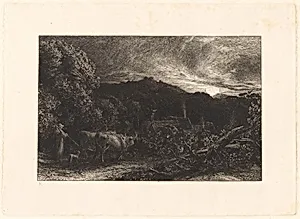
Medium
etching on wove paper
Dimensions
plate: 19 × 26.3 cm (7 1/2 × 10 3/8 in.) sheet: 30.8 × 43.9 cm (12 1/8 × 17 5/16 in.)
Classification
Department
CG-E
Museum
National Gallery of Art, Washington, D.C.
Credit
Rosenwald Collection
Accession Number
1943.3.9132
Rights
Public Domain
Art Historical Context
**The Weary Plough**, a poignant etching created by Samuel Palmer in 1858, captures quiet dignity of rural labor in Victorian England. Palmer, a leading figure in British Romanticism and a member of the visionary "Ancients" circle influenced by William Blake, often celebrated the pastoral idyll of the English countryside This print, measuring 19 ×26.3 cm on the plate, exemplifies his lifelong fascination with agrarian life, portraying a weary ploughman as a heroic, almost biblical figure against a serene landscape. Rendered in etching on smooth wove paper—a favored 19th-century support for its even texture and ability to hold fine ink—this work showcases Palmer's masterful intaglio technique. Etching allowed him to incise delicate lines into a metal plate, achieving rich tonal contrasts and luminous effects that evoke the golden hues of harvest twilight. By the late 1850s, amid Britain's Industrial Revolution, Palmer's idyllic visions served as a nostalgic counterpoint to rapid modernization, underscoring the timeless harmony between humanity and nature. Housed in the National Gallery of Art's Rosenwald Collection (Department CG-E), this print highlights Palmer's skill as a printmaker and his enduring influence on later landscape artists. Visitors will appreciate its intimate scale—sheet size 30.8 × 43.9 cm—inviting close contemplation of rural resilience and artistic reverence for the everyday sublime.
About the Artist
Samuel Palmer · 1805–1881
Samuel Palmer was born on 27 January 1805 in Newington, London, the son of a bookseller and sometime Baptist minister. He had little formal schooling and almost no conventional artistic training, yet he possessed an instinctive gift for drawing that led him to exhibit Turner-inspired works at the Royal Academy when he was only fourteen years old. In 1824 his mentor, the painter John Linnell, intro...