
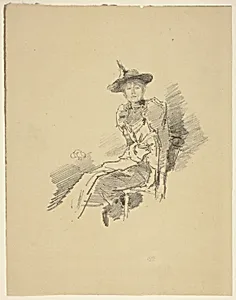
The Winged Hat
Medium
Transfer lithograph in black on tan laid paper
Dimensions
Image: 17.9 × 17.4 cm (7 1/16 × 6 7/8 in.); Sheet: 30.8 × 24.1 cm (12 3/16 × 9 1/2 in.)
Classification
transfer lithograph
Department
Prints and Drawings
Museum
Art Institute of Chicago
Accession Number
139545
Rights
Public Domain
Art Historical Context
James McNeill Whistler’s *The Winged Hat*1890) is a captivating transfer lithograph in black ink on tan laid paper, the artist’s mastery of printmaking. Measuring just 17.9 × 17.4 cm for the image on a larger 30.8 × 24.1 cm sheet, intimate work belongs to the Art Institute of Chicago’s Prints Drawings collection. Whistler, the American-born expatriate (1834–1903) renowned for his Aestheticist principles and subtle tonal harmonies, created this during his mature career, when he championed “art for art’s sake” amid London’s vibrant art scene. Transfer lithography, Whistler’s favored technique here, involved drawing on paper that was then chemically transferred to a lithographic stone, allowing fluid, painterly lines and velvety blacks impossible in etching. The tan laid paper—its textured chain lines visible—enhances the work’s warm, atmospheric depth, echoing Whistler’s famous nocturnes and portraits like *Arrangement in Grey and Black No. 1*. Likely depicting a figure in a whimsical, wide-brimmed hat evoking flight or fantasy, it reflects his interest in elegant, evocative forms over literal narrative. This print exemplifies Whistler’s innovative bridge between painting and print, influencing modern graphic arts. Visitors will appreciate its delicate subtlety, a testament to late-19th-century experimentation in reproducibility and beauty.
About the Artist
James McNeill Whistler · 1834–1903
James Abbott McNeill Whistler (1834-1903) was an American-born painter and printmaker who became a leading figure in the Aesthetic Movement and pioneer of Tonalism and Japonisme. He revolutionized art by championing "art for art's sake" and treating paintings as visual equivalents of musical compositions, titling works as "arrangements," "harmonies," and "nocturnes" to emphasize formal qualities o...