
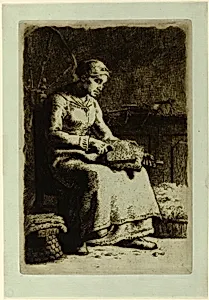
The Wool-Carder
1855–56
Medium
Etching on bluish-green laid paper hinged on left side to ivory card
Dimensions
Image: 25.6 × 17.4 cm (10 1/8 × 6 7/8 in.); Primary support: 29.6 × 20.6 cm (11 11/16 × 8 1/8 in.); Secondary support: 35.5 × 25.3 cm (14 × 10 in.)
Classification
etching
Department
Prints and Drawings
Museum
Art Institute of Chicago
Accession Number
47374
Rights
Public Domain
Art Historical Context
Jean-François Millet's *The Wool-Carder* (1855–56) captures the quiet dignity of rural labor through the meticulous medium of etching on bluish-green laid paper. intimate print, measuring just 25.6 × 17.4 cm, depicts a wool-carder at work—likely a peasant carefully combing raw wool fibers to prepare them for spinning. Housed in the Art Institute of Chicago's Prints and Drawings Department, it exemplifies Millet's mastery of printmaking, where acid etches intricate lines into a metal plate, allowing for subtle tonal variations and textures that evoke the grit and rhythm of everyday toil. As a leading figure in the French Realist movement and the Barbizon school, Millet shifted art away from romanticized ideals toward authentic portrayals of 19th-century French peasant life. Created during a time of social upheaval and industrialization, this work highlights the enduring value of manual crafts, imbuing humble tasks with profound humanity. The unusual bluish-green paper adds a soft, atmospheric hue, enhancing the etching's moody depth. Etchings like this were revolutionary for their accessibility—Millet produced them to reach wider audiences beyond oil paintings. Today, *The Wool-Carder* reminds us of the artistry in ordinary labor, inviting visitors to appreciate the interplay of light, texture, and resilience in Millet's vision.