
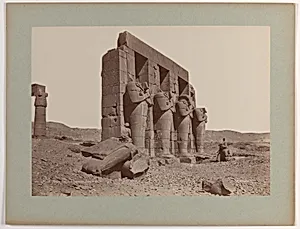
Thèbes, Temple de Ramasseum, Colosses brisés
1870s
Medium
Albumen silver print
Dimensions
Image: 10 9/16 × 14 7/8 in. (26.8 × 37.8 cm) Mount: 13 7/8 × 18 1/16 in. (35.2 × 45.9 cm)
Classification
Photographs
Department
Photographs
Museum
Metropolitan Museum of Art, New York, NY
Credit
Gift of Charles Isaacs and Carol Nigro, 2015
Accession Number
2015.777.2
Rights
Public Domain
Tags
Art Historical Context
In the 1870s, French photographer Émile Béchard captured the ruins of ancient Egypt in his albumen silver print *Thèbes, Temple Ramasseum, Coloss brisés*. This evocative image depicts the shattered colossi—massive fallen statues of Pharaoh Ramesses II—at his grand mortuary temple in Thebes (modern Luxor). Built around 1250 BCE to honor the warrior-king's deeds and ensure his eternal legacy, the Ramesseum once boasted towering figures symbolizing divine power, but earthquakes and time left them dramatically broken, evoking the fragility of even the mightiest empires. Béchard's photograph, with its rich tonal range and sharp detail characteristic of the albumen process—made by coating paper with egg white and silver salts—served as a vital document of 19th-century archaeological fascination. During Egypt's era of European exploration, such images brought the wonders of the Nile Valley to Western audiences, fueling Egyptomania in art and culture. Housed in the Metropolitan Museum of Art, this 10 9/16 × 14 7/8 in. print invites us to ponder the interplay of ancient grandeur and photographic preservation, bridging millennia through light and chemistry.