
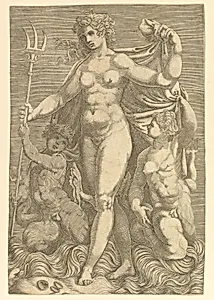
Thetis Standing with Two Tritons
Medium
Engraving
Dimensions
sheet: 8 7/8 x 6 1/16 in. (22.5 x 15.4 cm) borderline
Classification
Prints
Department
Drawings and Prints
Museum
Metropolitan Museum of Art, New York, NY
Credit
Harris Brisbane Dick Fund, 1947
Accession Number
47.100.712
Rights
Public Domain
Tags
Art Historical Context
Behold *Thetis Standing with Twoons*, a captivating 16th-century engraving that brings the mythological underwater realm to life. Attributed to the masterful engraver Giorgio Ghisi possibly after designs by the Mannerist painter Perino delaga (Pietro Buonaccorsi) or an anonymous Italian artist, this print depicts the sea goddess Thetis poised gracefully between two muscular Tritons—merman-like attendants symbolizing the sea's power and allure. Measuring just 8⅞ × 6¹⁄₁₆ inches, its intimate scale invites close inspection at the Metropolitan Museum of Art, acquired through the Harris Brisbane Dick Fund in 1947. Engravings like this were revolutionary in the Renaissance, allowing intricate designs to be reproduced and widely shared across Europe. Ghisi's technique shines here: fine, cross-hatched lines create depth, texture, and shimmering movement in the figures' flowing hair and scaly tails, evoking the fluidity of Mannerist style with its elegant, elongated forms and dynamic poses. Perino del Vaga, a key figure in the Roman Mannerist circle influenced by Raphael, often infused such scenes with classical mythology drawn from Ovid and ancient sources. This artwork reflects the era's fascination with antiquity, blending pagan gods with artistic virtuosity to celebrate human anatomy and nature's wonders. A delightful window into 16th-century print culture, it reminds us how engravings democratized high art for collectors and scholars alike.
About the Artist
Giorgio Ghisi|Perino del Vaga (Pietro Buonaccorsi)|Anonymous, Italian?, 16th century · 1520–1582
Giorgio Ghisi (c. 1520–1582) was one of the most accomplished engravers of the Italian Renaissance, renowned for translating the monumental compositions of Raphael, Giulio Romano, and Michelangelo into the exacting medium of the burin. Born in Mantua, he trained in an environment shaped by the legacy of Giulio Romano's decoration of the Palazzo del Te, and the grandeur of that Mannerist tradition ...