
Three Bathers
1894
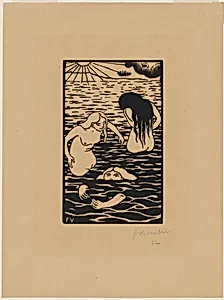
Medium
lithograph in black on brown wove paper
Dimensions
image: 18.3 x 24.7 cm (7 3/16 x 9 3/4 in.) sheet: 32.9 x 24.7 cm (12 15/16 x 9 3/4 in.)
Classification
Department
CG-E
Museum
National Gallery of Art, Washington, D.C.
Credit
Virginia and Ira Jackson Collection
Accession Number
2000.180.118
Rights
Public Domain
Art Historical Context
**Three Bathers** (1894) by Félix Vallotton is a lithograph in black on brown wove paper measuring 18.3 x 24.7 cm. Created during Vallotton's early career in Paris, this print captures the intimate scene of three female bathers with his signature precision and economy of line. Housed in the National Gallery of Art Virginia and Ira Jackson CollectionDepartment CG-E), it exemplifies the Swiss-born artist's mastery of the print medium, where lithography allowed for subtle tonal variations on the warm brown paper, enhancing the work's moody, contemplative atmosphere. Vallotton, a key figure in the Nabis movement alongside Pierre Bonnard and Édouard Vuillard, rejected Impressionism's loose brushwork for a more graphic, flattened style influenced by Japanese woodcuts. This piece reflects the fin-de-siècle fascination with modern nudes and everyday intimacy, blending realism with decorative simplicity. His bold contours and minimal shading create a sense of detachment, inviting viewers to ponder the figures' quiet vulnerability. As a classified print, **Three Bathers** highlights lithography's role in democratizing art in the 1890s, bridging fine art and reproduction. Vallotton's technique—crisp lines drawn directly on the lithographic stone—produced velvety blacks that contrast beautifully against the paper's texture, making it a gem for collectors and a window into Symbolist-era sensibilities.
About the Artist
Félix Vallotton · 1865–1925
Félix Vallotton (1865–1925) was born in Lausanne, Switzerland, into a comfortable middle-class family, and moved to Paris in 1882 to enroll at the Académie Julian, where he studied under the portrait painter Jules Joseph Lefebvre and the history painter Gustave Boulanger. Paris would remain his home for the rest of his life, and he became a French citizen in 1900 following his marriage to the art ...