
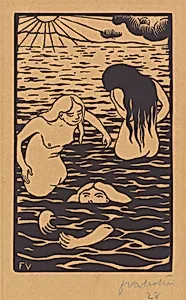
Three Bathers
1894
Medium
woodcut on beige wove paper
Dimensions
block: 18.2 x 11.2 cm (7 3/16 x 4 7/16 in.) sheet: 28.8 x 21.9 cm (11 5/16 x 8 5/8 in.)
Classification
Department
CG-E
Museum
National Gallery of Art, Washington, D.C.
Credit
Gift of Gaillard F. Ravenel and Frances P. Smyth-Ravenel
Accession Number
2000.7.39
Rights
Public Domain
Art Historical Context
Félix Vallotton's *Three Bathers* (1894) is a striking woodcut on beige wove paper, measuring a compact 18.2 x 11.2 cm on the block. Created during the artist's early years in Paris, this intimate print captures three nude figures in a serene bathing scene, rendered with Vallotton's signature precision and economy of line. As a Swiss-born painter and printmaker associated with the post-Impressionist group Les Nabis, Vallotton revitalized the woodcut medium, drawing inspiration from Japanese ukiyo-e prints to produce bold, flattened forms and dramatic contrasts. Vallotton's woodcuts from the 1890s, including this one, marked a departure from the softer etchings of his contemporaries, emphasizing sharp contours and subtle tonal gradations achieved through meticulous carving. The beige paper enhances the work's luminous quality, evoking a sense of quiet voyeurism and natural harmony. Printed at a time when modern art was challenging academic traditions, *Three Bathers* exemplifies Vallotton's influence on graphic arts, bridging fine art and illustration. Today, housed in the National Gallery of Art as a gift from Gaillard F. Ravenel and Frances P. Smyth-Ravenel, this print invites visitors to appreciate Vallotton's technical mastery and his fresh take on the female nude—a motif rich in Symbolist undertones. A gem for print enthusiasts!
About the Artist
Félix Vallotton · 1865–1925
Félix Vallotton (1865–1925) was born in Lausanne, Switzerland, into a comfortable middle-class family, and moved to Paris in 1882 to enroll at the Académie Julian, where he studied under the portrait painter Jules Joseph Lefebvre and the history painter Gustave Boulanger. Paris would remain his home for the rest of his life, and he became a French citizen in 1900 following his marriage to the art ...