
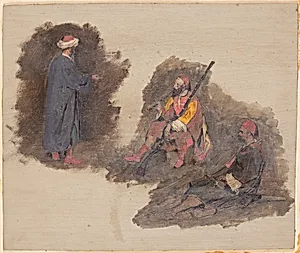
Three Bedouin Men
1868 - 1877
Classification
figures
Department
Smithsonian Collection
Museum
Smithsonian American Art Museum
Credit
Gift of Louis P. Church
Accession Number
1917-4-425-b
Rights
Public Domain
About this artwork
Research in Progress
Art Historical Context
Frederic Edwin Church, a master of the Hudson River School known for his monumental landscapes like *Niagara* and *Heart of the*, ventured beyond American wilderness in 1868. That year, he embarked on an ambitious journey to the Middle East, including Egypt and the Holy Land, with his family. *Three Bedouin Men*, between 1868 and1877, captures this exotic sojourn through intimate portraits of nomadic Arab figures—likely sketched on site and refined later. As a rare figure study from Church's oeuvre, it reflects his keen eye for cultural encounters amid his lifelong pursuit of sublime nature. Rendered in an unknown medium, the work exemplifies Church's precise realism and luminous detail, hallmarks of 19th-century American Romanticism. Bedouins, wandering tribes of the desert, symbolized the timeless East to Western artists, blending ethnographic curiosity with Orientalist fascination. This piece, classified simply as "figures," hints at preparatory work for larger biblical or landscape compositions inspired by his travels. Today, *Three Bedouin Men* graces the Smithsonian American Art Museum, a gift from Church's son, Louis P. Church. Though research continues, it offers visitors a window into the artist's global vision, bridging American art's romantic ideals with the human stories of distant lands.