
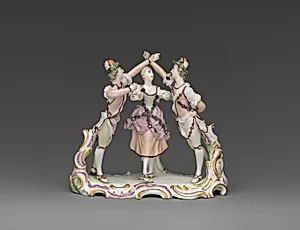
Three dancers
Medium
Hard-paste porcelain decorated in polychrome enamels, gold
Dimensions
Overall: 6 1/8 × 6 3/4 in. (15.6 × 17.1 cm)
Classification
Ceramics-Porcelain
Culture
German, Ludwigsburg
Department
European Sculpture and Decorative Arts
Museum
Metropolitan Museum of Art, New York, NY
Credit
Gift of R. Thornton Wilson, in memory of Florence Ellsworth Wilson, 1950
Accession Number
50.211.225
Rights
Public Domain
Tags
Art Historical Context
This delicate porcelain group, created around 1763 at the Ludwigsburg Porcelain Manufactory under the direction of modeler Joseph Nees, captures three dancers in mid-movement with remarkable grace. Standing just over six inches tall, the figures are rendered in hard-paste porcelain—a material European factories had only recently mastered after decades of experimentation to rival prized Chinese imports. The piece is vividly painted in polychrome enamels and accented with gold, highlighting the swirling skirts, expressive gestures, and lively interaction among the dancers. Produced during the height of the Rococo period in the German court culture of Württemberg, the sculpture reflects the era’s fascination with theatrical entertainment and aristocratic leisure. Such small-scale figural groups were designed for intimate display in porcelain cabinets or on dining tables, serving both as decorative objects and subtle displays of wealth and refined taste. Ludwigsburg’s output, though less famous today than Meissen, contributed significantly to the spread of porcelain artistry across Europe. The work’s charm lies in its ability to freeze a fleeting moment of dance within a fragile medium, reminding viewers of the eighteenth-century delight in movement, music, and social performance.