
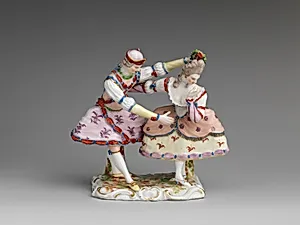
Two dancers
Medium
Hard-paste porcelain decorated in polychrome enamels, gold
Dimensions
Overall (confirmed): 5 15/16 x 6 3/8 x 3 9/16 in. (15.1 x 16.2 x 9 cm)
Classification
Ceramics-Porcelain
Culture
German, Ludwigsburg
Department
European Sculpture and Decorative Arts
Museum
Metropolitan Museum of Art, New York, NY
Credit
The Jack and Belle Linsky Collection, 1982
Accession Number
1982.60.191
Rights
Public Domain
Tags
Art Historical Context
Created around 1760–63 at the Ludwigsburg Porcelain Manufactory in Germany, *Two Dancers* captures the elegance of Rococo court life in a delicate hard-paste porcelain group. Modeler Joseph Nees shaped the small figure pair—measuring just under six inches high—to depict a gentleman and lady mid-step, their gestures and costumes reflecting the graceful social dances popular among European aristocracy. The use of polychrome enamels and gold highlights the factory’s technical skill, allowing vibrant colors and shimmering details to bring the scene to life. As one of several German porcelain manufactories established in the mid-eighteenth century, Ludwigsburg competed with the renowned Meissen works to produce luxury tableaus and cabinet pieces. These small sculptures served not only as decoration but also as conversation pieces that celebrated contemporary fashion, theater, and leisure. The hard-paste material, perfected in Europe only decades earlier, enabled fine modeling and durable, luminous surfaces that enhanced the lively movement of the dancers. Today in the Metropolitan Museum’s European Sculpture and Decorative Arts collection, the work offers visitors a charming glimpse into Enlightenment-era taste and the remarkable artistry of German porcelain.
About the Artist
Joseph Nees|Ludwigsburg Porcelain Manufactory ( |German) · 1758 |1758 –1773 |1824
active 1758–73|German, 1758–1824