
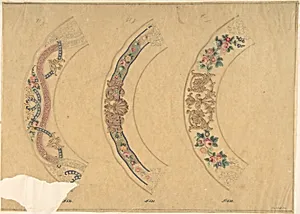
Three Designs for Plate Borders (recto); Three Designs for Plate Borders (verso)
19th century
Medium
On recto, graphite, watercolor, gouache, and gold gilt. Framing lines in graphite. On verso, brush and brown wash.
Dimensions
sheet: 9 3/4 x 13 9/16 in. (24.8 x 34.4 cm)
Classification
Drawings
Department
Drawings and Prints
Museum
Metropolitan Museum of Art, New York, NY
Credit
The Elisha Whittelsey Collection, The Elisha Whittelsey Fund, 1953
Accession Number
53.675.31
Rights
Public Domain
Tags
Art Historical Context
This delicate double-sided sheet from 19th-century France showcases three floral border designs on both recto and verso, likely as preparatory sketches for porcelain or silver plate edges. Rendered by an anonymous artist, these works reflect the era's passion for ornate decorative arts, when workshops buzzed with pattern-makers fueling France's booming luxury goods industry—from Sèvres porcelain to elegant tableware. The intricate motifs of flowers and leaves evoke Romantic revival of nature-inspired elegance, blending whimsy with refinement. On the recto, the artist masterfully layered graphite for precise framing lines, vibrant watercolor and gouache for color depth, and shimmering gold gilt to mimic the opulence of finished metalwork or ceramics. The verso offers simpler, atmospheric studies in brush and brown wash, highlighting the iterative process of design refinement. Measuring just under 10 by 14 inches, this intimate drawing captures the artistry behind everyday luxury. Housed in the Metropolitan Museum of Art's Drawings and Prints department through The Elisha Whittelsey Collection (1953), it invites us to appreciate the unsung designers whose patterns graced 19th-century dining tables across Europe, bridging fine art and functional beauty.
About the Artist
Anonymous, French, 19th century · 1800–1900
**Anonymous, French, 19th Century (ca. 1800–1900)** The artist cataloged as Anonymous, French, 19th century embodies the enigmatic yet essential contributions of unidentified creators to France's vibrant 19th-century art world. Active roughly between 1800 and 1900, this figure—or potentially collective workshop—produced a diverse array of works amid the nation's transition from Neoclassicism thro...